
A person born in 1900 could have grown up with the earliest aeroplanes, then lived long enough to watch astronauts step onto the Moon on television.
The first powered flight came in December 1903. Apollo 11 landed in July 1969. Less than 66 years separated those moments—a span short enough to fit inside a life, with room left over for childhood and old age. NASA’s account of the Wright brothers’ first flight puts that extraordinary distance in perspective.
Imagine trying to explain the second event to someone who had just witnessed the first. Yes, the machine flies. No, that is not the astonishing part. Their grandchildren will watch people walk on another world.
We tend to describe this as the march of technology, as though history had settled into a brisk, predictable stride. It was closer to a series of doors opening, each revealing the tools needed to open the next.
Why did human progress accelerate so dramatically? The answer reaches further back than the last hundred years, and it involves more people than the handful of famous inventors whose names we remember.
The past was never standing still
Our ancestors were not waiting around for someone to become clever. They built cities, navigated oceans, developed mathematics, improved crops and worked metal. Knowledge travelled through trade, migration, conquest, teaching and translation.
Nor was the nineteenth century a long pause before the twentieth. Someone born in 1826 and living until 1900 could encounter railways, photography, telegraphy, telephones and electric lighting. Where they lived, and what they could afford, would determine how much of that transformation entered their home.
The useful distinction is between having an ingenious idea and living in a society equipped to turn it into an everyday service.
Hero of Alexandria described a steam-powered device in the first century CE. Heated water made a sphere turn. The Smithsonian describes the aeolipile as a precursor of the steam engine. But a spinning sphere was not a factory power system waiting for someone to attach a belt.
A useful industrial engine also needed reliable construction, fuel, maintenance, finance and a task it could perform economically. The gap between a demonstration and a working industry can be enormous.
The person holding the book
Picture two people trying to solve the same problem in different towns. Each has a promising idea. Neither knows the other exists.
Now give them access to the same printed account, a way to correspond, and somewhere to publish a correction. Their chances of getting further improve. One person’s failed experiment can save another person months.
Printing did not begin with Johannes Gutenberg. Chinese woodblock printing and later movable type preceded his European system by centuries. The Library of Congress traces that Asian history, including Bi Sheng’s ceramic type in the eleventh century and Korean metal type in the thirteenth.
Gutenberg’s achievement in fifteenth-century Mainz was nevertheless transformative for European book production. Reproducible pages helped create a larger world of readers, arguments and shared references.
A printed page was not automatically true. Printing could multiply an error as efficiently as a discovery. What mattered was the growing opportunity to compare accounts, challenge a claim and put an experiment in front of someone capable of checking it.
Scientific institutions helped turn that opportunity into a practice. The Royal Society’s publishing history begins in 1665 with Philosophical Transactions. Ideas could enter an ongoing conversation rather than remain the private property of a single workshop.
The reader at the other end became part of the invention.
The work that muscle could not do
A book could explain a pump. It could not power one.
For much of history, work depended heavily on human and animal effort, supplemented by water and wind. Those sources could achieve remarkable things, but they imposed practical limits on where power was available and how much could be concentrated in one place.
Steam widened those possibilities. James Watt did not invent the steam engine; he made crucial improvements to an existing technology. His separate condenser, developed in the 1760s and patented in 1769, reduced the waste involved in repeatedly heating and cooling the working cylinder. The Science Museum explains the breakthrough and the years of work needed to make it useful.
That last part is easy to lose in the telling. There was an insight, then there were models, materials, imperfect parts, money and persistent effort. A brilliant thought still had to survive the workshop.
More efficient engines made mechanical power useful across a wider range of businesses. Those businesses created demand for better machines and people who could build them. Improvement began generating the conditions for further improvement.
Knowledge and energy were essential ingredients. They were not the whole recipe. Economic historian Robert Allen’s explanation of British industrialisation emphasises wages, profitability and expanding markets tied to empire. An invention had to make sense to somebody paying for it. The origins of the industrial economy cannot be separated neatly from the political and commercial world around it.
Progress had people inside it
Leaving a field for a factory did not necessarily mean leaving hardship behind.
Children worked in industrial mills. Adults faced long hours and dangerous conditions. The machine could increase output without giving the person beside it much control over the working day.
Britain’s 1833 Factory Act introduced restrictions on child employment and a factory inspectorate. Such reforms are a reminder that improved machinery and improved lives are related achievements, but they are not the same achievement.
Technology created possibilities. Campaigners, workers, public institutions and political decisions helped determine who benefited from them.
That question has not gone away. It follows every large promise about automation into the room: who gains time, who loses income, and who gets to decide?
When invention became a team sport
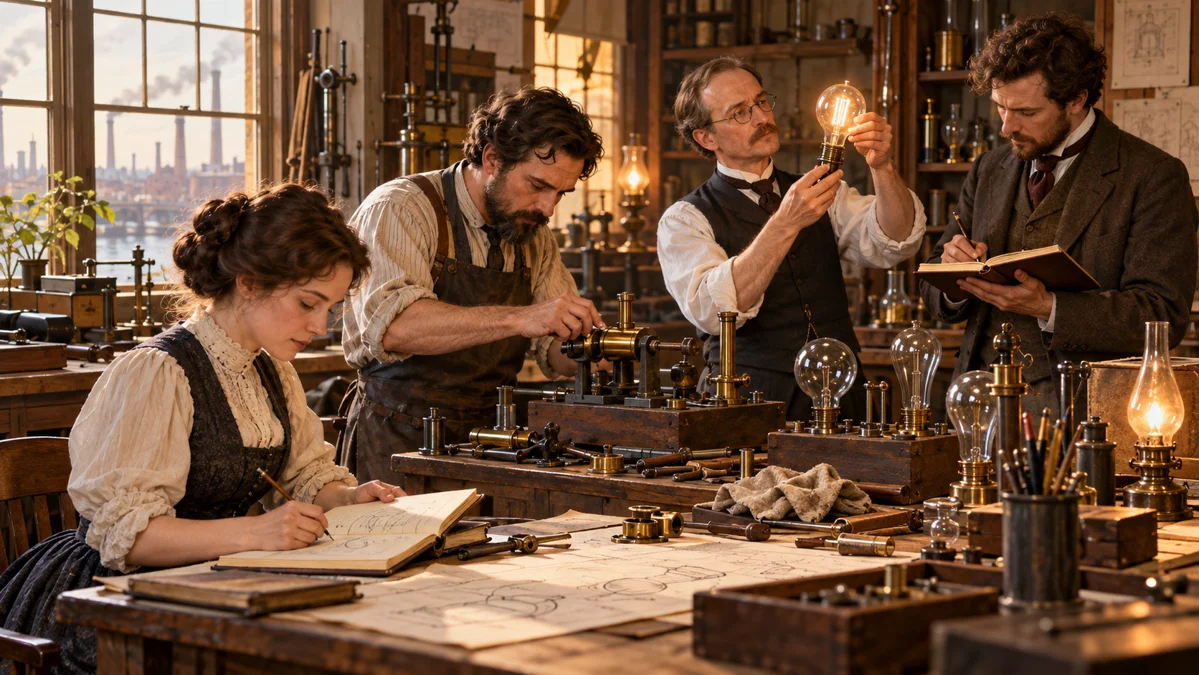
In 1876, Thomas Edison moved his operation to Menlo Park, New Jersey. The laboratory brought assistants, equipment and experiments together in a place built for sustained invention. The National Park Service’s biography describes the facility and the wider electrical system developed around his lighting work.
The important word is system. A successful lamp needed more than a glowing filament. It needed generation, distribution and the other practical pieces that would let customers use it.
There is a similar lesson in the laboratory itself. A team can try several approaches, record what happened and carry on when one person is absent. A colleague’s mistake becomes useful information. Specialised skills meet at the same bench.
The familiar portrait of the lone inventor has its place. But it leaves an awful lot of people outside the frame.
One famous name may appear on the building. Many hands make the building work.
The machines that worked on information
Steam could move machinery. Electricity made power easier to distribute. Electronic computing added the ability to carry out calculations at a scale and speed that changed what people could attempt.
ENIAC, built in the 1940s, is often remembered as a roomful of equipment. The Computer History Museum’s account also puts people at its controls, including programmers Frances Bilas and Betty Jean Jennings. Configuring a problem meant arranging connections and switches; keeping thousands of vacuum tubes working required skilled maintenance.
The computer did not arrive with its usefulness already installed. People had to learn how to make it useful.
That relationship continues. Better tools let researchers model a design, test an idea or search a body of information that would overwhelm an unaided person. The results can help build better tools in turn.
It is one reason the modern pace feels different. We have learned to improve some of the equipment we use to make improvements.
But a machine’s ability to process information is not a guarantee that its conclusion is sound. Faster calculation can serve a bad assumption. Wider distribution can spread a convincing falsehood. The need to check an answer survives every improvement in the equipment producing it.
The future still has to be built
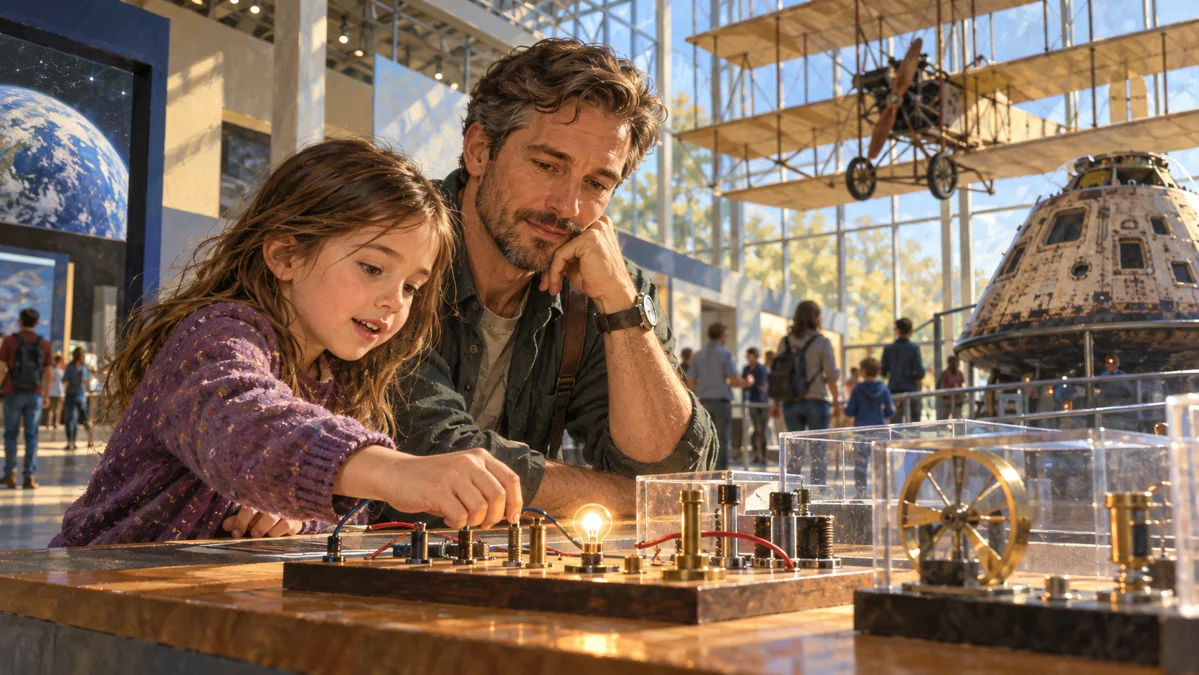
Artificial intelligence brings that tension into sharper focus. It can assist with searching, coding and scientific prediction, while raising difficult questions about reliability, ownership and decisions delegated to machines.
Protein research offers a concrete example. The 2024 Nobel Prize in Chemistry recognised computational protein design and protein-structure prediction, including the work behind AlphaFold2. Software had become a powerful tool for investigating the building blocks of life.
A predicted structure is a starting point for further work, not a finished treatment. Experiments, safety testing, manufacturing and access still matter. The distance between an impressive result and a patient helped is another version of the old gap between the spinning steam sphere and a useful engine.
Our feature on the debate over AI control examines what happens when greater capability is accompanied by less human oversight. The history of progress gives us reasons for ambition. It does not provide a warranty.
There is no timetable requiring the next breakthrough to arrive sooner than the last. Some fields advance rapidly; others encounter stubborn physical, economic or institutional barriers. A sequence of selected milestones cannot tell us when a disease will become treatable or what a child’s working life will look like.
What history does show is that the future has repeatedly been made by people who inherited useful tools and found another use for them.
The Wright brothers did not have to invent every material, every calculation or every craft their aeroplane required. Apollo’s engineers did not begin where the Wrights began. Each generation received a world of work already done—and a world of work still waiting.
That is the most human part of this story. Somewhere, someone is learning to use a tool that did not exist when their parents were young. They may spend years getting nowhere. They may find the small improvement that lets somebody else go much further.
We cannot know what today’s children will live long enough to see.
We can decide how much opportunity they will have to help build it.
Watch: Why human progress accelerated
Mark Doco explores how knowledge, energy and invention changed the pace of human progress.