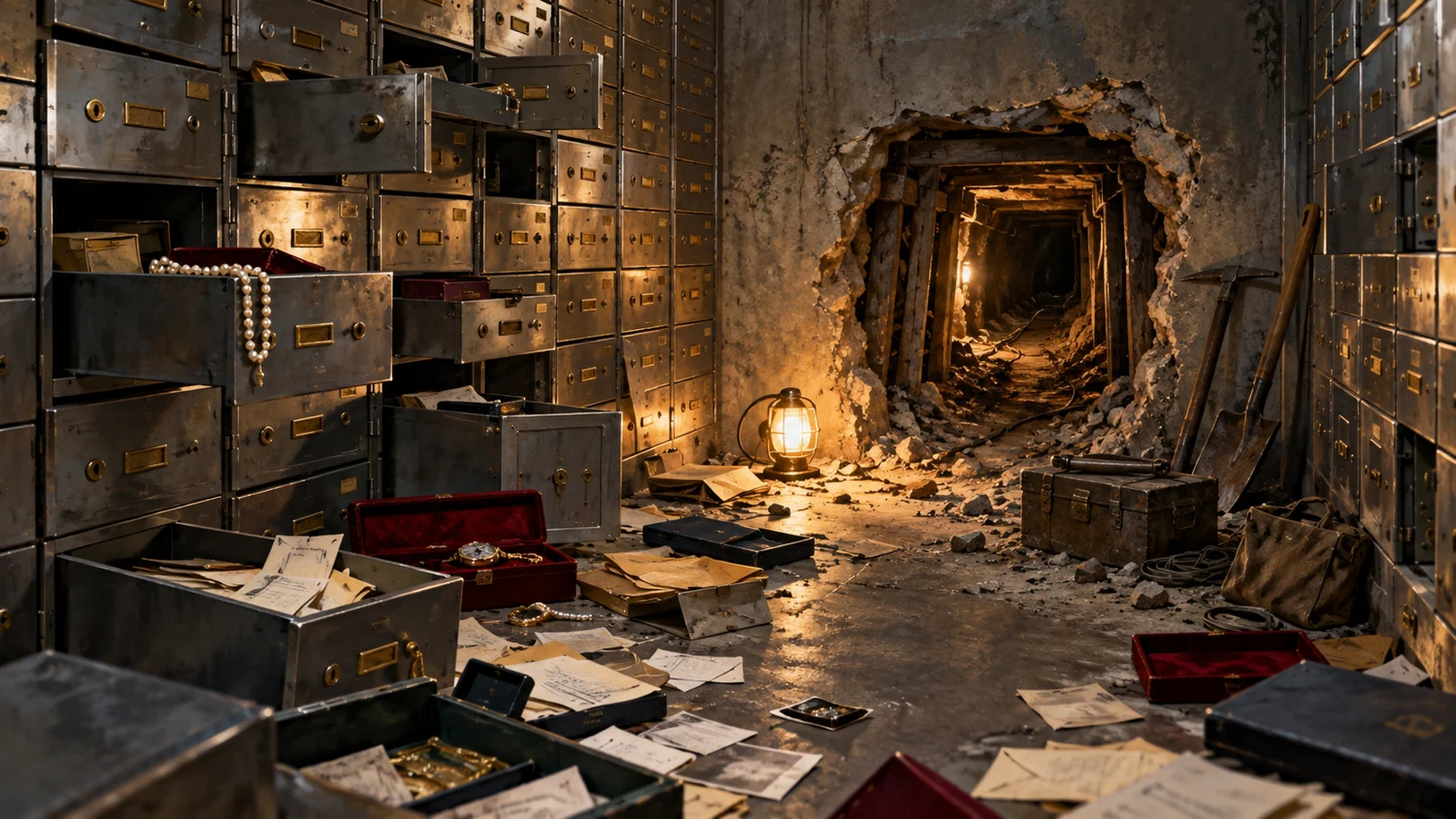
On July 19, 1976, staff at Société Générale in Nice faced a problem nobody expected. The vault door would not open.
At Société Générale in central Nice, the barrier meant to protect the valuables had become an obstacle to discovering what had happened to them. The thieves had welded it shut from inside. When staff finally gained access, the strongroom had been ransacked.[1]
The story quickly travelled beyond the French Riviera. Someone had reached the bank through the sewers, emptied hundreds of safe-deposit boxes and escaped with cash, gold and jewellery. There had been no confrontation with tellers, no queue of hostages and no getaway from the front steps under police fire.[2]
The entrance was underground. So was the exit.
And the man who became the face of the crime would later find another unexpected way out: a courthouse window.
A photographer with another life
Albert Spaggiari worked as a photographer in Nice. That was the respectable occupation attached to the name that would soon appear in newspapers around the world. But his history included military service in Indochina, imprisonment and involvement with the OAS, the extremist organisation opposed to Algerian independence.[3]
It is a part of the story that matters. Spaggiari was eventually packaged as a charming outlaw—a man with enough imagination to outwit a bank and enough nerve to outwit a judge. His politics were considerably darker than that image suggests. Contemporary reporting examined his far-right associations and his claim that the robbery had a political purpose. His explanation was a claim, not a verified account of where the money went.[3]
The appeal of his public character is easy to understand. A photographer makes a more surprising central figure than an anonymous career thief. He had an ordinary job, a recognisable face and a story to tell. Once that face became familiar, a complicated gang operation could be reduced to one name.
The city underneath the city
The essential insight was to approach the strongroom from outside the world the bank’s customers could see. The sewers offered proximity to the target without passing through its public entrance.
An often-repeated account says Spaggiari rented a safe-deposit box and left an alarm clock inside it, using the absence of a response as a test of the vault’s security. The anecdote is a striking introduction to the plot, although retellings differ over how he first discovered the opportunity.[4]
What followed demanded much more than an ingenious thought. The crew worked underground over a period of months. They had to excavate a passage, remove debris and keep working in conditions that were hardly suited to delicate work. By the time the opening reached the strongroom, the bank’s formidable exterior had become largely irrelevant.[4]
Reports describe an approximately eight-metre tunnel connecting the municipal sewer system to the vault. Its short length disguises the scale of the operation: this was a passage made in secret, beneath an occupied city, to reach a very particular room.[5]
That is the detail that gives the robbery its extraordinary quality. Much of the work happened before there was anything spectacular for anyone to notice. Above ground, the bank continued to look like a bank. Below it, the crew was changing the terms of its security.
A weekend inside the strongroom
During the weekend of July 17–19, the thieves had the vault largely to themselves. The approach gave them something armed robbers rarely enjoy: time.[6]
They could sort, open and discard. Safe-deposit boxes held the valuables of individual customers, so the job involved working through separate stores of property rather than simply collecting a bank’s cash supply. The scene they left behind showed the difference between entering a strongroom and emptying it.
The evidence also suggested that the men had made themselves comfortable. Investigators found food remains and wine bottles. Those details were irresistible to newspapers: a gang dining in the very room it was robbing, treating a place of institutional security as a private retreat.[1]
They left a message whose wording varies slightly between accounts but whose meaning became inseparable from the story: no weapons, no violence, no hatred.[1]
It was excellent publicity for the thieves. It allowed a theft to be remembered for what the perpetrators said they had avoided, rather than for what the customers had lost.
There is an important difference between a robbery without a shooting and a robbery without victims. When news spread, anxious customers crowded the bank to learn whether their boxes had been opened. For them, the cleverness of the route offered little consolation.[1]
How much disappeared?
The value of the haul was difficult to establish. The original losses were assessed in French francs; later accounts commonly give an estimate of approximately 46 million francs.[2]
That is a useful measure of the scale, rather than a final audited total. Private boxes do not make a convenient public inventory, and accounts differ over both the value and the number opened. A modern dollar equivalent depends on which historical estimate, exchange rate and inflation calculation a writer chooses.
The solid point is that the thieves took an enormous haul for the period. A precise dollar headline adds an appearance of certainty that the underlying figures do not justify.
The missing fortune became part of the appeal. It left room for the question that accompanies almost every great heist story: where did the money go?
The investigation catches up
For all the preparation, the gang could not control what happened after the theft. Investigators pursued connections between suspected criminals, suspicious activity before the robbery and the stolen property.
A later reconstruction describes a villa outside Nice that attracted police attention before the raid, and an attempt to sell numbered gold ingots after it. Arrests brought investigators to Francis Pellegrin and Alain Bournat, and ultimately to Spaggiari.[5]
In October, Spaggiari had been travelling in Japan with a delegation associated with Nice mayor Jacques Médecin. Police arrested him on his return, on October 27, 1976.[5]
The arrest did not end the performance. Spaggiari claimed responsibility for initiating the heist, while questions about the rest of the operation remained unanswered.[9]
That combination was powerful. He could offer enough of a story to establish himself as its star without supplying everything investigators needed. The crime had acquired a narrator who was also a suspect.
The window
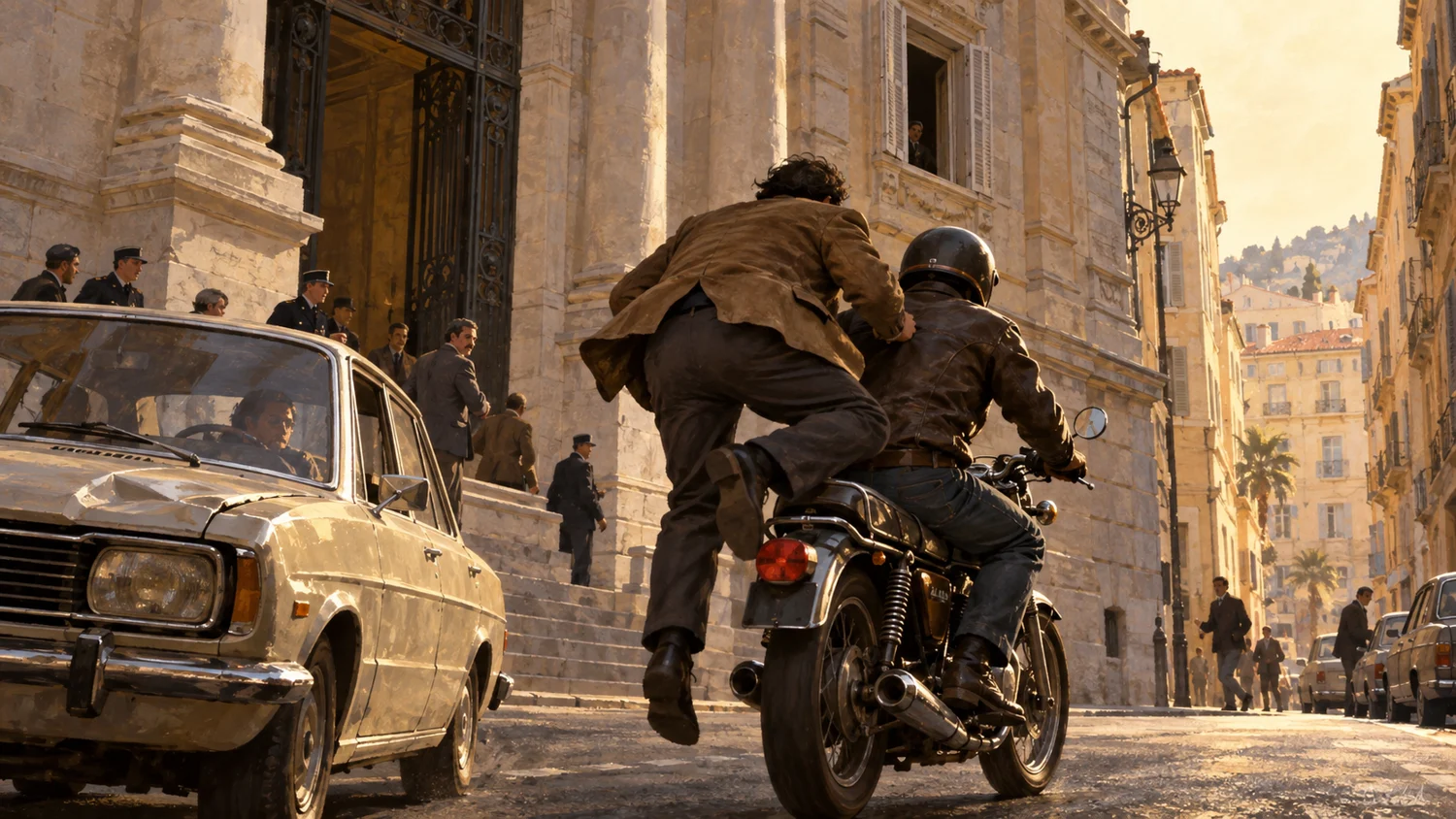
On March 10, 1977, Spaggiari was brought to investigating judge Richard Bouazis at the Palais de Justice in Nice. He produced a plan of the vault and appeared ready to explain it. Then he broke away, opened a window and jumped.[7]
A ledge and the roof of a parked car interrupted his descent. A motorcycle accomplice was waiting. Spaggiari climbed aboard and disappeared into the old city. The scene was witnessed; it was no invention added for a later film.[7]
The escape changed the story’s centre of gravity. A tunnel could be measured. A breached wall could be photographed. The man who had stepped through a window could now be anywhere.
A fugitive who kept telling the story
Spaggiari remained beyond the reach of French police. Accounts of his years on the run describe travel, concealment and appearances that kept his name alive. His book, Les Égouts du paradis, gave him another way to shape how the robbery would be remembered.[8]
A criminal’s memoir has an obvious attraction: it promises access to the person who was there. It also has an obvious weakness: the storyteller has a stake in the story. Boasting, omission and self-justification can survive perfectly well alongside accurate detail.
Spaggiari was sentenced to life imprisonment in his absence. The disappearance was therefore an evasion of punishment, not an acquittal.[9]
The proceedings did not provide a clean ending for the whole affair. Reporting from the 1979 trial described a case with six defendants and substantial unanswered questions. Many of the people who had actually entered the vault were missing from the proceedings.[6]
In June 1989, reports announced that Spaggiari had died of lung cancer and that his body had been brought to his mother’s home in Hyères. He had been a fugitive for twelve years.[10]
The man could no longer answer questions. The story kept attracting them.
Another man claims the plan
In 2010, Jacques Cassandri published La Vérité sur le casse de Nice under the name Amigo. He claimed the central organising role for himself, challenging the version in which Spaggiari was the operation’s mastermind.[9]
That boast had consequences. Investigators examined whether the robbery’s proceeds had been laundered into assets and businesses. At his 2018 trial, Cassandri retreated from the book’s claim and described it as fiction.[9]
He received a 30-month sentence for other offences, including misuse of company assets, concealed employment and influence-peddling. He was acquitted of laundering the Nice robbery’s proceeds. The outcome did not establish him as the judicially confirmed replacement mastermind.[9]
It did, however, make the familiar story harder to tell with complete confidence. Spaggiari’s prominence is beyond dispute. His claim to sole creative ownership of a complicated operation is another matter.
What remains beneath the legend
The Nice heist has the shape of a film even when told with restraint: a hidden approach, a room full of valuables, a taunting message and a suspect who escapes through a window. It needs very little embellishment.
The difficulty is that the neatest version belongs partly to the people who benefited from it. The message in the vault supplied the gang’s preferred moral framing. Spaggiari supplied a memorable leading character. Later, Cassandri supplied a competing author.
Meanwhile, the customers remained outside that performance, waiting to learn what had happened to their property.
Fifty years after the break-in, the most interesting question is no longer simply how the thieves got inside. It is how much of the story they managed to take with them when they left.
The official French-language Faites entrer l’accusé documentary revisits the robbery and escape with accounts from people involved in the investigation.
Fifty years later
Il y a cinquante ans, la Société générale de Nice se fait dérober 50 millions par Albert Spaggiari, un ancien de l’OAS. En cavale, il donnera des interviews, notamment à Genève.
— 24 heures (@24heuresch) July 21, 2026
Swiss newspaper 24 heures remembers the robbery on its fiftieth anniversary. Its post uses a rounded estimate of the haul.