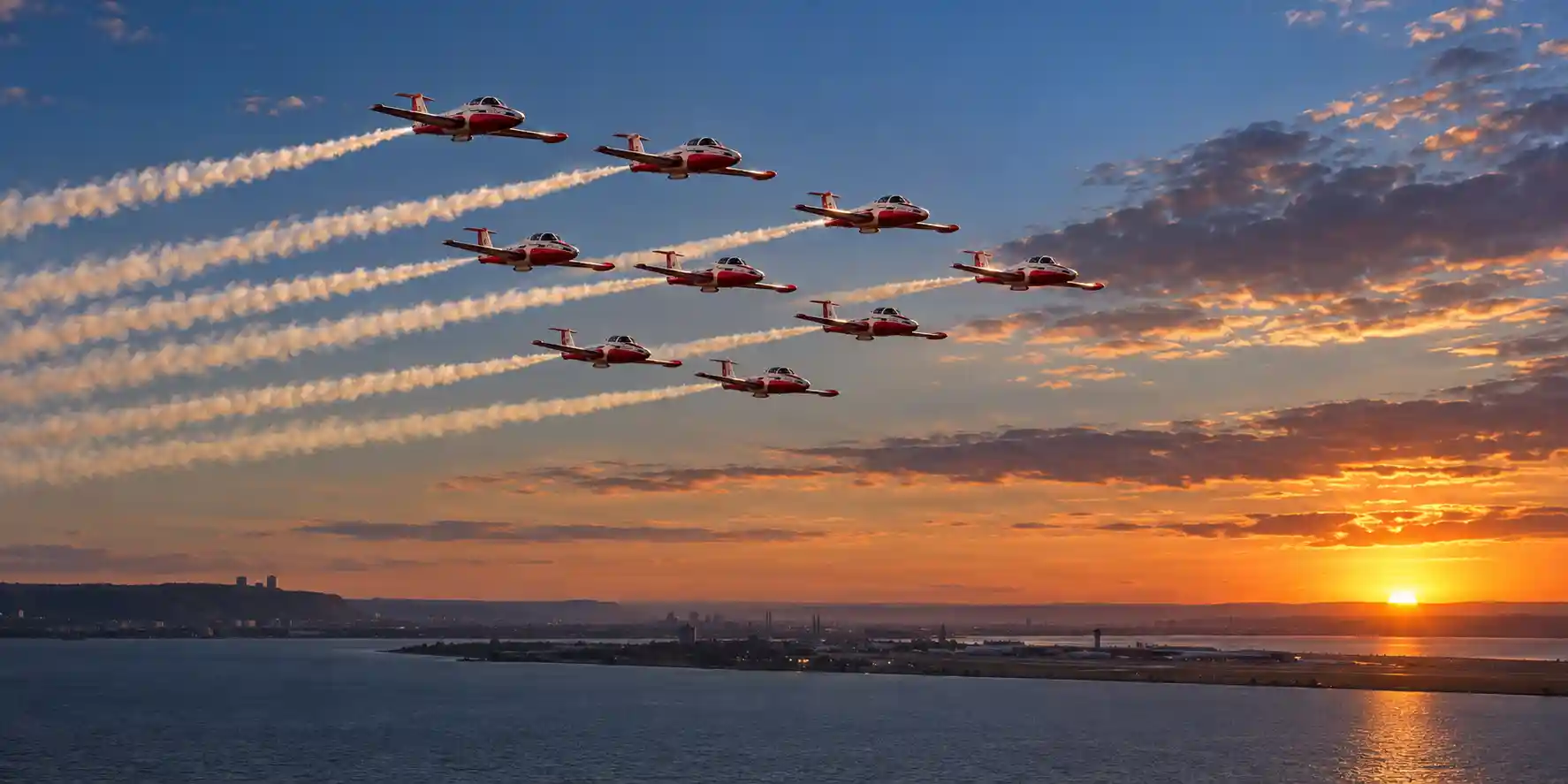
Hamilton, Ontario, Canada -The Canadian Forces Snowbirds are reaching the end of an era.
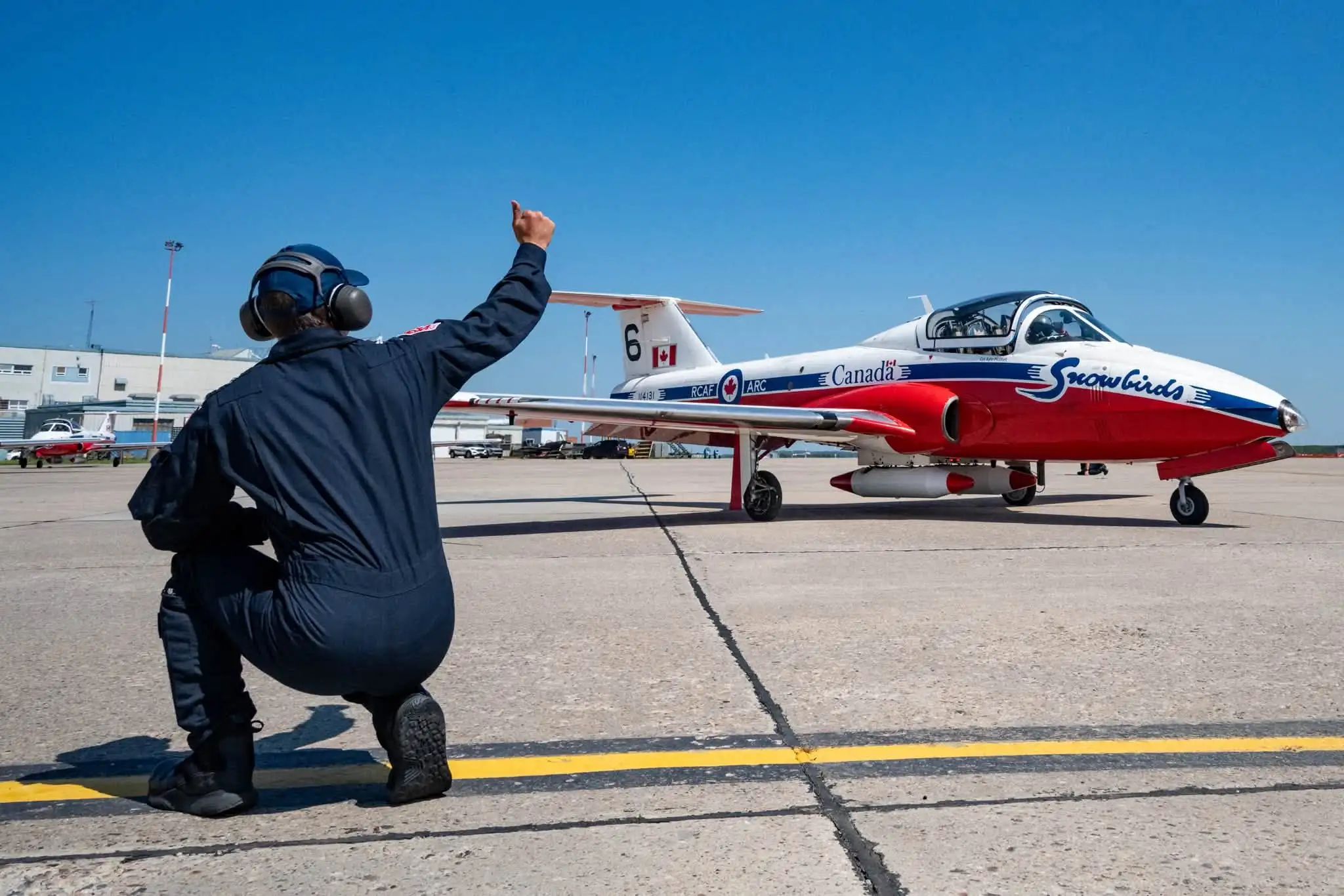
After 55 years of performances in their distinctive red-and-white CT-114 Tutor jets, the team will complete its final season with the aircraft in 2026. The Tutors will then be retired, and the Snowbirds will disappear from Canadian skies until replacement aircraft become operational—possibly in 2030, although the government more cautiously says the “early 2030s.”
The government insists the Snowbirds have not been cancelled. New aircraft are coming. The name, squadron and famous nine-plane formation are intended to survive.
Technically, that is true.
Emotionally—and perhaps institutionally—it feels like something much closer to an ending.
The future Snowbirds will fly the CT-157 Siskin II, Canada’s designation for the Swiss-designed Pilatus PC-21. It is a fast, agile and highly advanced turboprop trainer powered by a Canadian-made Pratt & Whitney engine. It is already used by several air forces and is entirely capable of supporting an impressive aerobatic team.
The PC-21 is not the problem.
The problem is what Canada has done to the actual Snowbirds while waiting for it.
Canada's best! Thank you Snowbirds for all you've done over the years!!!@CFSnowbirds pic.twitter.com/G6m0TDNBgV
— Today's Northumberland (@NT_pfisher) September 6, 2026
A Farewell Without a Handover
The Snowbirds should have been allowed to evolve in public.
Several PC-21s could have arrived while the Tutors were still operating. Canadian pilots and technicians could have begun conversion training years ago. The original Snowbirds could have performed their celebrated nine-plane routine, followed by three new aircraft demonstrating simpler formations.
The following year, the new group might have expanded to four or six aircraft. Its pilots could have progressively developed a more ambitious routine while learning directly from the existing team.
Eventually, Canada could have staged a ceremonial final performance involving both generations: the original Tutors making their last pass as the new Snowbirds assumed the formation.
It would have been a magnificent national moment.
Instead, the Tutors are being given a farewell and the replacements are coming sometime later. There will be no meaningful handover in the air—only years of silence between two versions of the team.
That is not a transition. It is an interruption.
Worse, it appears that detailed planning for the people left behind may only now be beginning.
During a recent CityNews report from Hamilton International Airport, a Snowbirds representative was asked what team members would be doing during the long break.
“It’s tough to say,” he replied, explaining that planning was only beginning following the announcement and that the travelling team was too busy with its final show season to examine the question fully until the summer was over.
That answer should trouble anyone who believes the Snowbirds are more than a collection of airplanes.
The decision to suspend the team was announced before its own people could clearly explain what would happen to them during the suspension.
The Planes Are Old—But That Is Not the Answer
The CT-114 Tutor entered Royal Canadian Air Force service in 1963. It became the Snowbirds’ aircraft in 1971 and ceased serving as Canada’s principal military trainer in 2000.
Nobody can reasonably argue that the Tutors should fly forever.
Maintaining a small fleet of more than 60-year-old aircraft is increasingly difficult. Airframe fatigue must be carefully monitored. Replacement components become scarce. Avionics become obsolete. Specialized engineering and maintenance costs rise.
These are also aerobatic aircraft. They perform tight formations, operate at low altitude and repeatedly endure stresses far beyond those encountered by an aircraft making an occasional ceremonial flight.
The government is entitled to conclude that the Tutor has reached the end of its practical operating life.
But the age of the Tutor answers only one question:
Why must the old aircraft eventually retire?
It does not answer the much more embarrassing question:
Why was the new team not ready?
The Canadian government had decades of warning. Defence officials reportedly recommended beginning the replacement process as far back as 2003, when the Tutor was expected to become increasingly difficult and expensive to sustain.
Instead, its service life was repeatedly extended.
After the fatal 2020 Snowbirds crash in Kamloops, the Department of National Defence said a Tutor Life Extension Project would modernize the aircraft and permit continued operations until 2030. Approximately $30 million was reportedly committed to extending and upgrading the fleet.
Now the Tutors are being retired in 2026.
Perhaps recent engineering assessments uncovered problems that made the previous 2030 objective impractical. If so, Canadians should be shown a clear explanation of what changed.
But even an unexpected airworthiness problem in 2026 would not explain why no successor was already being prepared after more than two decades of warnings.
The CFL proudly welcomes the final flight of the iconic Canadian Forces Snowbirds to Canada's biggest championship celebration - the 113th Grey Cup in Calgary, AB pic.twitter.com/dI40Kt99w3
— CFL (@CFL) September 3, 2026
“Roll Them Into the Hangars”
My father was an engineer. He was also a pilot.
I can imagine exactly what he would have said about this situation:
“Roll those planes into the hangars, get to work on them, while you figure out a solution. Period.”
He would not have been demanding that unsafe airplanes continue performing. He would have wanted engineers to examine every available option before allowing the Snowbirds to disappear.
Strip the aircraft down. Inspect and grade each airframe. Identify the Tutors with the greatest remaining structural life. Determine which components can be refurbished or manufactured. Examine whether the performance schedule can be reduced. Consider a smaller formation or a less demanding routine.
If the final engineering conclusion is that the aircraft cannot fly safely, then they do not fly.
But “these aircraft are old” would not have satisfied him as an engineering diagnosis.
Hamilton’s Canadian Warplane Heritage Museum continues to operate one of the world’s few airworthy Avro Lancaster bombers—an aircraft approximately two decades older than the Tutor. The comparison is not exact. The Lancaster flies far less frequently and does not perform a nine-aircraft aerobatic routine.
Nevertheless, its continued operation demonstrates what Canadian aviation knowledge can accomplish when maintaining an historic aircraft is treated as a serious objective.
My father’s next observation would probably have been even blunter:
“They just spent all the money deciding what not to do.”
There were studies, life-extension projects, consultations, briefing papers, procurement processes and discussions of interim aircraft. The RCAF reportedly considered rapidly purchasing or leasing an interim demonstration capability in 2019 and rejected the option.
Everyone participated in the process. Budgets were consumed. Reports were completed. Salaries were paid.
And the Snowbirds still ended up without an aircraft.
“I’m sure they all got well paid,” my father would have added.
That is more than cynicism. It describes a system in which everyone can perform an assigned administrative function while nobody remains personally responsible for achieving the obvious final objective:
Keep the Snowbirds flying.
What Howard Hughes Would Have Asked
Howard Hughes would have found this intolerable.
Hughes was obsessive, difficult and frequently unreasonable. But aviation was tangible to him. An aircraft was designed, built, tested, inspected, modified and flown. Problems demanded precise answers.
He would not have objected automatically to retiring the Tutors. If engineers showed that the airframes had reached their safe operating limits, he would have accepted the evidence.
What would have enraged him was the absence of overlap.
The Pilatus PC-21 is not an experimental aircraft waiting to prove itself. It first flew in 2002. The Swiss Air Force began training pilots on it in 2008. More than 200 had been delivered worldwide by the end of 2019.
Five years ago, it was already an established military trainer.
Hughes would have wanted to know why Canada did not acquire several aircraft in advance, place experienced Snowbirds pilots into conversion training and begin developing a demonstration program while the Tutors were still flying.
He would have asked for an aircraft-by-aircraft Tutor assessment, the PC-21 acquisition schedule, the pilot-conversion plan, the maintenance plan and the date of the first mixed-generation performance.
Most of all, he would have demanded the name of the person responsible for ensuring continuity between the two teams.
He would probably then discover that no single person was responsible for that outcome. Different offices were responsible for airworthiness, procurement, training, budgets, contracts and personnel.
The result belonged to everyone—and therefore to no one.
Hughes might have looked across the table and asked:
“You had the pilots, the engineers, a proven replacement aircraft and twenty years of warning. How did you arrange a farewell instead of a handover?”
There is no convincing answer.
Snowbirds!!!! 🇨🇦🇨🇦🇨🇦🇨🇦🇨🇦 pic.twitter.com/oSCyfYFbW1
— Mike Miller (@popartcartoonz) September 4, 2026
The Actual Snowbirds Cannot Be Stored
Ottawa appears to view the Snowbirds as a capability that can be temporarily placed in administrative storage.
Retire the Tutors. Reassign personnel. Wait for the PC-21s. Reconstitute the team later.
But the Snowbirds are not simply a name, crest and paint scheme. They are a living accumulation of knowledge.
Pilots must learn to fly extremely close to one another. Team leaders must understand the abilities and instincts of individual members. Technicians acquire specialized knowledge of aircraft being operated under unusual demands. Planners coordinate weather, airports, fuel, logistics, safety requirements and public appearances across an entire continent.
That culture is transmitted continuously from one team to the next.
A four-, five- or six-year interruption risks dispersing the very people who possess that experience. Pilots will receive other assignments. Technicians will move into different roles. Organizers will adjust their events. Institutional memory will fade.
The government can preserve the title “Snowbirds.” It cannot place a working human organization in a box and assume it will emerge unchanged sometime in the next decade.
Former Snowbirds personnel have warned that rebuilding after such a long hiatus could resemble starting from scratch. The government’s own language says the team will “ultimately” return to its distinctive nine-plane formation.
That carefully chosen word suggests the first returning version may be smaller and less developed than the team Canadians are losing.
Those Planes Were the Snowbirds
For 55 years, Canadians did not experience the Tutor as interchangeable government equipment.
Those planes were the Snowbirds.
Their shape, sound, red-and-white paint and nine-aircraft formations became inseparable from the team’s identity. Canadians who watched them as children later brought their own children and grandchildren.
Comments beneath recent farewell videos read more like an obituary than reactions to a temporary fleet replacement:
“I pray they return.”
“Hopefully we’re all still here in the 2030s.”
“Grew up watching them with my dad.”
“Snowbirds memorialised on a Canadian banknote please.”
The public has heard Ottawa’s promise that the Snowbirds will return. It simply does not entirely believe it.
That distrust is rational. “Early 2030s” is not a firm date. Governments change. Budgets tighten. Contracts slip. Priorities are reconsidered. After several years without performances, some future review could easily ask whether rebuilding a nine-aircraft demonstration team remains worthwhile.
The future PC-21 Snowbirds may be excellent. The aircraft is modern, attractive and well suited to precision formation flying. Given time, it could create a new tradition of its own.
But it will not make the ending of the Tutor era disappear.
An Insult to Canadian Aviation
Canada possesses one of the great aerospace traditions.
This country built the Tutor. It produced the Avro Arrow, Beaver, Otter, Twin Otter, Dash 8 and Challenger family. Canadian engineers, pilots and technicians have repeatedly demonstrated their ability to design, manufacture, maintain and operate exceptional aircraft.
That is why the Snowbirds hiatus feels like more than another delayed government purchase.
It feels like an insult to Canadian aviation—and to the public’s intelligence.
Canadians are being told that because the Tutors are old, the disappearance of the Snowbirds for several years is somehow unavoidable.
It was not unavoidable.
Aircraft retirement was inevitable. The empty years between aircraft were a planning decision.
If preserving the Snowbirds as a continuously operating national institution had been the objective, the old and new teams would have overlapped. Pilots would already be training. PC-21 demonstration routines would be under development. Canadians would be watching a new generation grow under the guidance of the original team.
Instead, the government allowed a predictable aircraft problem to become an organizational emergency. It selected a reasonable replacement only after the gap had become unavoidable and then presented the promise of a future team as though it had saved the existing one.
It did not save the existing Snowbirds.
It gave them a farewell.
The Empty Sky Is the Failure
The Tutor had to retire eventually. The PC-21 is a credible successor. Neither fact excuses what happened in between.
This should have been a story about renewal: old aircraft teaching new aircraft, experienced pilots guiding their successors and Canadians watching the Snowbirds move visibly from one era into another.
Instead, it became a story about absence.
My father would have rolled up his sleeves and sent the aircraft into the hangars.
Howard Hughes would have demanded the drawings, inspection reports and transition schedule—and refused to leave until someone explained the gap.
Both would have understood the same basic truth:
You do not preserve an aviation institution by grounding it, dispersing its people and promising to reconstruct it years later.
You preserve it by keeping its knowledge alive and transferring that knowledge directly from one generation to the next.
The government says the Snowbirds will return.
Perhaps they will.
But when those nine Tutor jets make their final pass and their smoke disappears, the original Snowbirds will be gone. Canada will then look upward at an empty sky created not by technology, age or necessity, but by decades of indecision followed by one hurried conclusion.
The PC-21 is not the scandal.
The scandal is that Canada turned what should have been a handover into an ending.