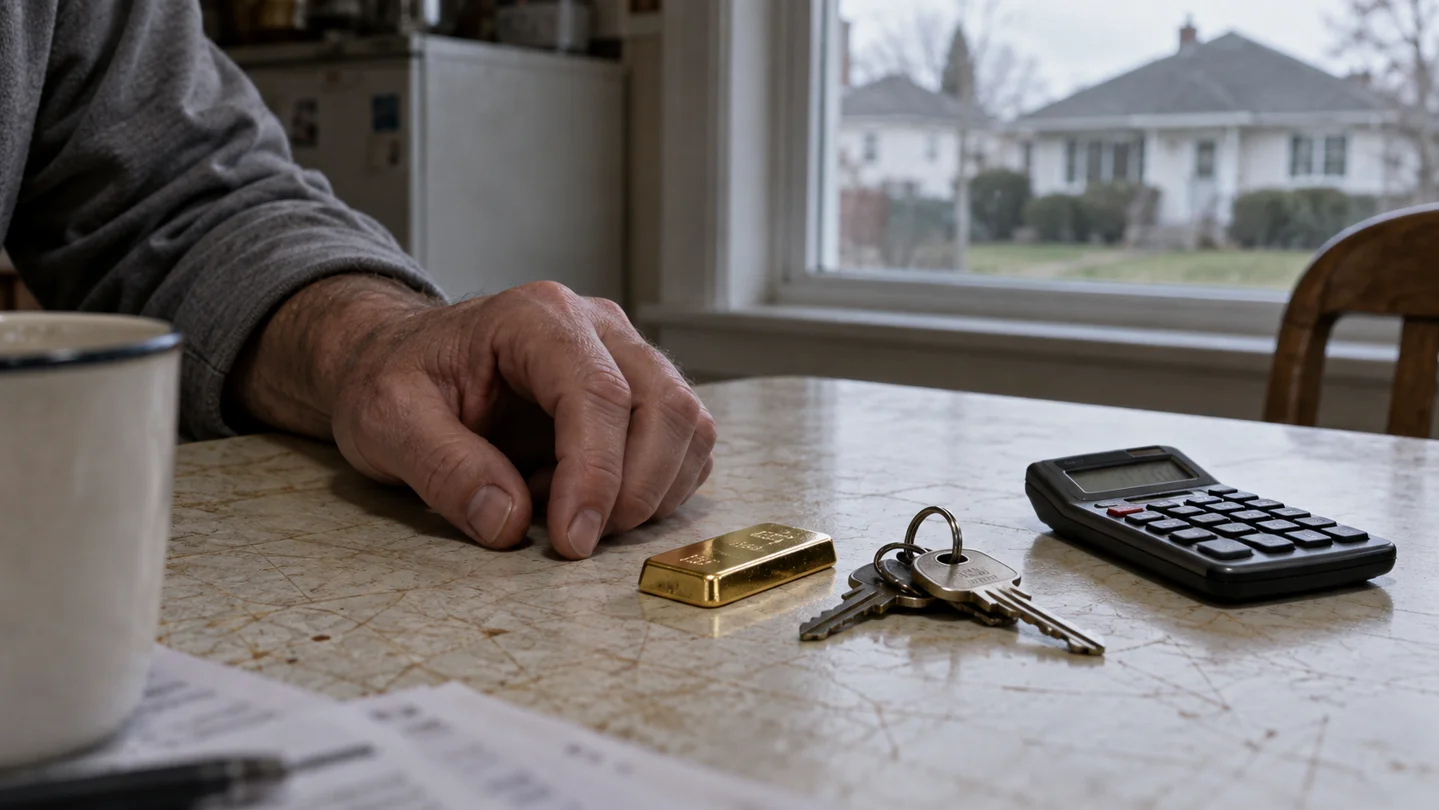
A house, a car, an acre of land and a steer walk into a gold dealer’s shop. There is probably a joke in there somewhere. There is also a surprisingly good question.
What if we stopped looking at their prices in dollars for a moment and counted the ounces of gold instead?
The idea comes from a rancher talking through the arithmetic at sunrise in the Ozarks. His examples are ordinary things: somewhere to live, something to drive, land to work and an animal to raise. The price tags have swollen since 1980. Measured in gold, some look remarkably familiar.
It is a fascinating way to look at money. It also needs a little care, because changing the measuring stick can reveal a great deal without explaining everything.
The half-million-dollar house shrinks
The roughly $500,000 figure has a real statistical basis. The Census Bureau and HUD series carried by FRED puts the average selling price of a new U.S. house at $502,700 in the second quarter of 2026. This is an average for new houses sold, not the median price of every American home.
Now choose a round gold price of $4,200 per troy ounce for a thought experiment. Divide $502,700 by $4,200 and the house costs about 120 ounces.
That $4,200 is a calculation benchmark, not an annual average or a dealer’s guaranteed offer. Reuters reported spot gold at $4,172.36 on October 12, illustrating why any current conversion needs a date and a price convention.
Go back to 1980. A simple average of the four quarterly new-home averages in the same FRED series is $76,375. With a rounded historical gold benchmark of $615 an ounce, consistent with the approximately $614 annual average recorded by Natural Resources Canada, that works out to about 124 ounces.
The dollar figure is more than six times larger. The gold figure is slightly smaller. A homebuyer counting dollars and a long-time bullion holder counting ounces can therefore look at the same market and tell very different stories.
An acre makes the point again
Land offers another striking comparison. USDA’s historical account puts average farm real estate at $737 per acre in 1980. Its 2026 Land Values report gives $4,500.
At our two gold benchmarks, that is about 1.20 ounces then and 1.07 ounces now.
*Illustrative conversions using $615 and $4,200 per troy ounce. Housing: simple mean of four quarterly averages for 1980; Q2 observation for 2026. Farm real estate includes land and buildings. These are mixed-period comparisons, not a matched annual index or a comparison of identical properties.
That qualification matters. A national acre combines very different locations and uses. USDA reports cropland separately at $6,020 per acre in 2026 and pasture at $2,000. You cannot take the national figure to a desirable patch of Iowa and expect the seller to honour it.
The car and the cow
The rancher’s car example has the same appeal: a $7,500 vehicle then, a $50,000 vehicle now. Using our benchmarks, those prices translate into about 12.2 and 11.9 ounces.
Those are his rounded examples, not a verified, consistently defined vehicle-price series. A modern car also brings different equipment, safety standards and capabilities. Similar gold prices do not make the vehicles identical.
Cattle need even more precision. A breeding cow and a 1,000-pound steer are different purchases. Weight, grade, location and the livestock cycle all matter. The old saying that an ounce of gold buys a cow is memorable; it is not a universal price list.
Still, the exercise gets us out of the familiar habit of treating the dollar price as the whole story. Sometimes the thing has become more valuable. Sometimes the unit used to measure it has become less powerful. Often several forces are moving together.
The awkward bit: 1980 was no ordinary starting line
A comparison between two dates can hide a rough journey. Gold surged above $800 an ounce in 1980, as the U.S. Geological Survey’s historical overview records. Starting near a boom makes the intervening years important.
In the rancher’s comparison, the house-to-gold ratio rises sharply around 2000. That is a reminder that purchasing power did not remain steady along the way.
Someone needing to buy a house during gold’s weaker years would have faced a different calculation from someone able to wait decades. An asset can have an impressive long-term record and still disappoint at the moment its owner needs the money.
A cheaper house in gold is still an expensive mortgage
Most people receive wages in money, pay bills in money and apply for mortgages in money. They do not arrive at a closing with a century’s supply of family bullion.
For them, affordability depends on income, the deposit, mortgage rates, taxes, insurance and the homes available where they need to live. A favourable gold ratio does not shrink the monthly payment.
Nor is money saved in an interest-bearing account or invested in productive businesses equivalent to banknotes left untouched in a drawer. A fair investment comparison needs income, reinvestment, costs and taxes, as well as changing prices.
Physical gold brings its own costs: dealer premiums, the gap between buying and selling prices, and sometimes storage and insurance. It pays no interest or dividend. The Commodity Futures Trading Commission cautions that precious metals can be volatile and past performance does not predict future returns.
What the ounces tell us
The rancher has found an engaging way to ask a serious question: what does our saved wealth actually buy?
A larger number on a statement feels like progress. But if the home, the car and the acre move further away, that feeling deserves examination. Gold provides another reference point, one with a very long history and a price that moves independently of the things we hope to purchase.
It is useful precisely because it changes the view. The $500,000 house becomes a roughly 120-ounce house. The acre becomes a little more than an ounce. Suddenly, a familiar price tag looks strange.
The mortgage lender will still want dollars. But once you have counted the ounces, you may never look at those dollars quite the same way again.
Explore Freeway66’s gold coverage · More stories about money