Seattle, WA, USA - Picture the scene.

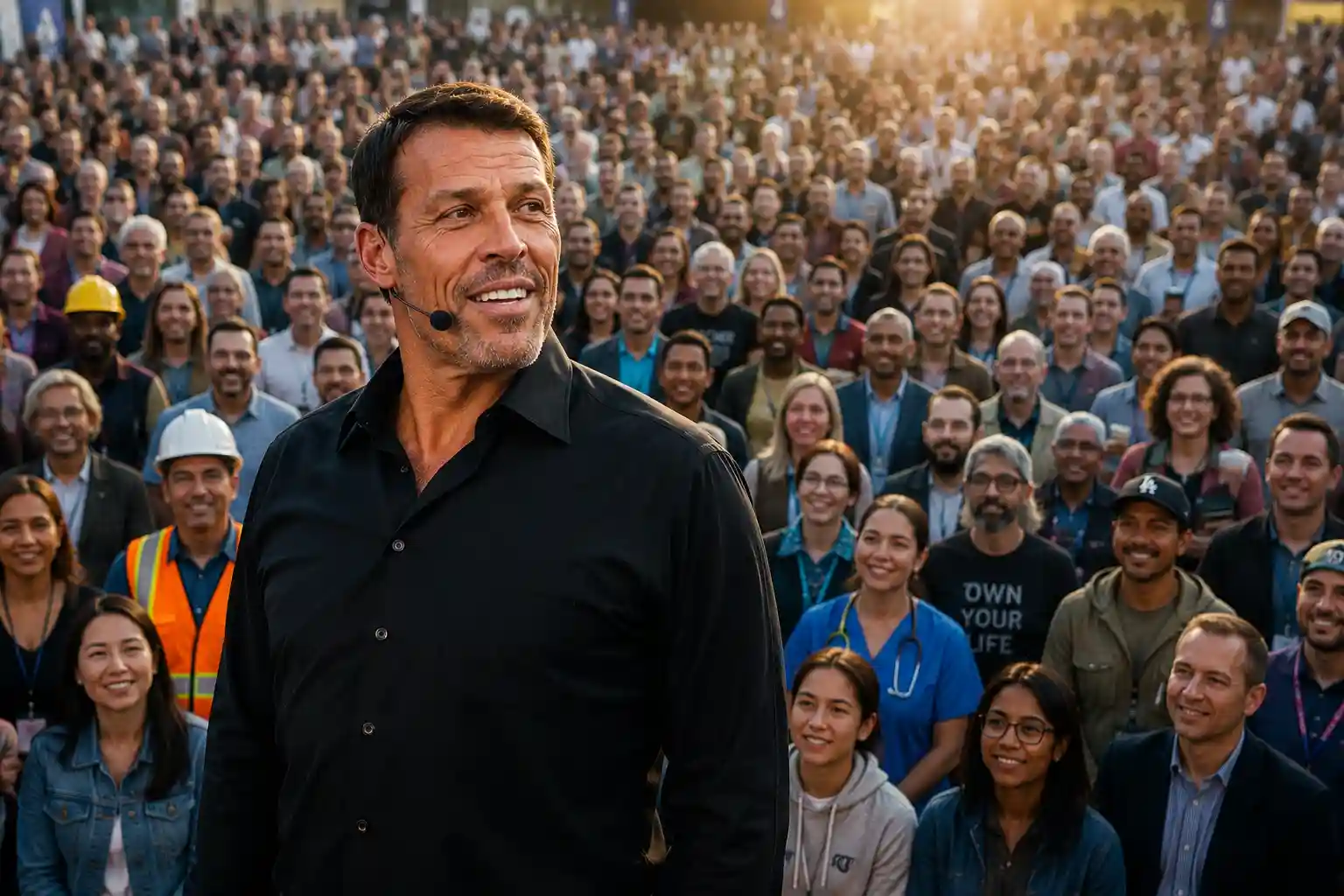
Tens of thousands of people have gathered from around the world. Music fills the room. Strangers encourage one another. Business owners, parents, students, executives and people quietly passing through difficult periods in their lives have all arrived with different stories.
Yet most of them are searching for roughly the same thing.
They want to believe that something can change.
At the centre of the room is Tony Robbins, the unmistakable six-foot-seven speaker with the gravelly voice, commanding presence and seemingly inexhaustible energy. For more than four decades, Robbins has encouraged people to examine their beliefs, manage their emotions, improve their relationships and take greater control of their decisions.
Some come looking for confidence. Others want direction, better health, a stronger business or the courage to make a long-delayed decision. A few may simply want to feel hopeful again.
This is what makes the Tony Robbins story about much more than one famous motivational speaker. It is part of a much older human story: the enduring belief that people can learn, adapt and build better lives.
Robbins did not invent personal development. What he did was bring it to an extraordinary scale—and continue adapting its delivery from cassette tapes and television infomercials to stadium events, digital programs and, most recently, artificial intelligence.
His greatest message may also be his simplest:
The future is not necessarily fixed.
Tony Robbins was born Anthony J. Mahavoric in California in 1960. He has spoken openly about a turbulent childhood marked by financial hardship and instability. He left home as a teenager, did not attend university and worked as a janitor before finding his way into the seminar business.
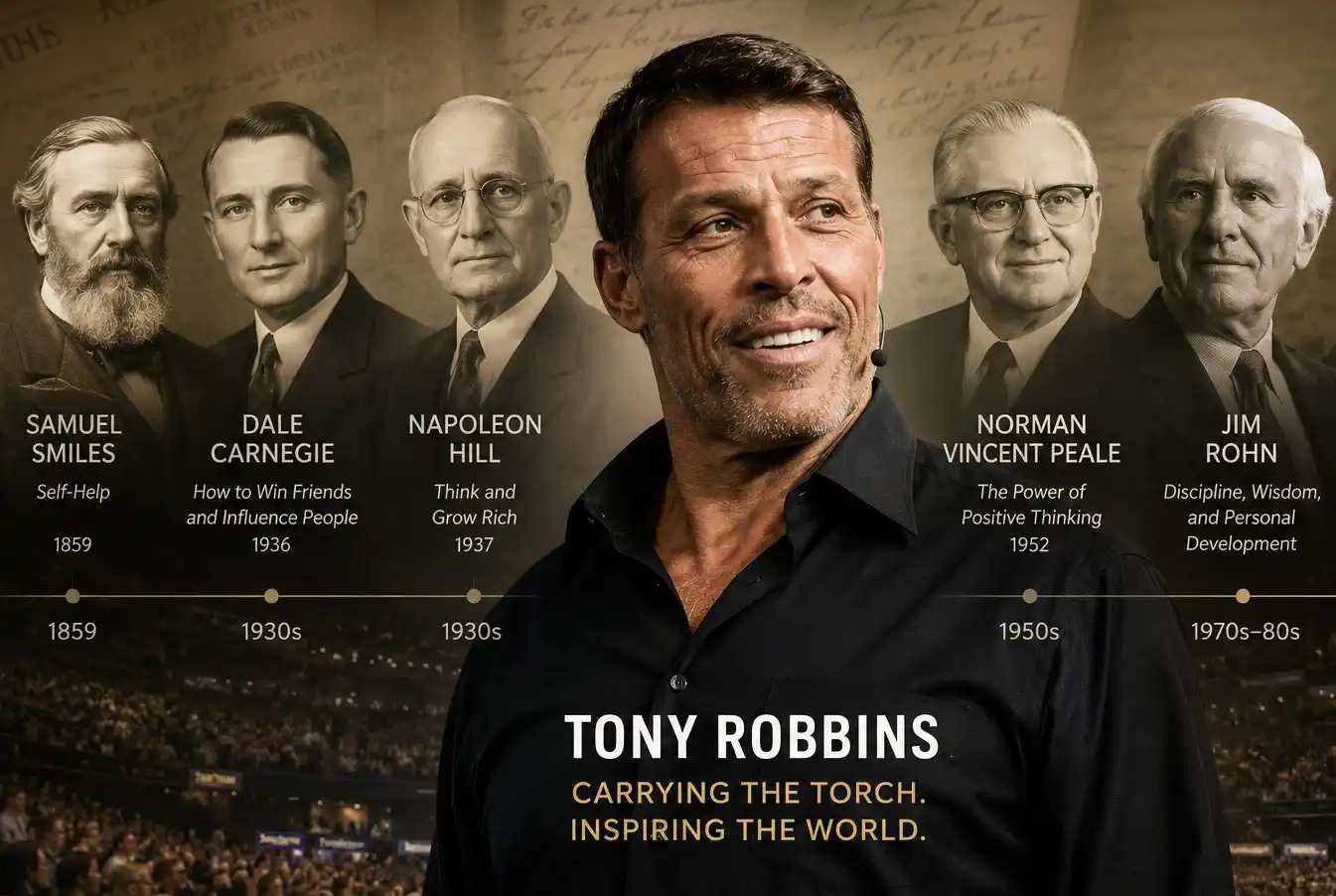
His route into personal development began through Jim Rohn, the influential American speaker and entrepreneur whose teachings emphasized discipline, responsibility, learning and the steady improvement of one’s character.
Robbins began promoting Rohn’s seminars while still a teenager. The Jim Rohn organization describes Robbins as a direct mentee who worked with Rohn for four years, and Robbins has credited Rohn with laying the foundation for much of his later work.
That relationship is important because it reveals something sometimes missed in stories about extraordinary success: even the person who eventually becomes the teacher usually begins as a student.
Robbins listened, learned and studied how ideas could move people. He later incorporated techniques drawn from psychology, communication training and neuro-linguistic programming into his own presentations. By the 1980s, his energetic seminars and widely distributed audio programs had made him one of the best-known figures in the growing personal-development industry.
His books helped carry the message further. Unlimited Power, published in 1986, explored personal performance and communication. Awaken the Giant Within, released in 1991, focused on decisions, beliefs, habits and emotional control. Decades later, Robbins expanded into personal finance with Money: Master the Game and Unshakeable.
The evolution mattered. Robbins was no longer simply telling people to become enthusiastic. He was discussing health, leadership, investing, business strategy, relationships and the practical systems behind change.
According to his official professional profile, his programs, videos and events have reached more than 50 million people across 195 countries.
Numbers that large are difficult to comprehend. They also raise a worthwhile question.
Why have so many people listened?

The desire for guidance is hardly new.
Long before podcasts, online coaching and arena seminars, people searched for books, teachers and philosophies that could help them live with greater purpose.
In 1859, Scottish author Samuel Smiles published a book with the remarkably direct title Self-Help. It celebrated perseverance, character, thrift, independence and personal improvement. The book became one of the defining works of Victorian self-development and had sold more than a quarter-million copies by the time of Smiles’ death.
Smiles wrote for an industrial age in which education and economic opportunity were expanding, but life remained hard and social mobility was far from guaranteed. His message was that character and sustained effort could still matter.
Later generations produced their own voices.
Dale Carnegie concentrated on public speaking, communication and human relationships. His courses began in New York, and his 1936 book How to Win Friends and Influence People became one of the most enduring works in the field. Carnegie’s central insight was that success often depends not only on intelligence or technical ability, but also on understanding other people.
Napoleon Hill explored ambition, planning and belief. Norman Vincent Peale combined faith with optimism and popular psychology. Earl Nightingale used radio and recorded audio to speak about goals, purpose and the direction of one’s thoughts.
Jim Rohn brought many of these themes into the modern seminar era. His style was calmer than Robbins’, but his ideas were powerful: work harder on yourself than you do on your job; continue learning; accept responsibility; and understand that small disciplines, repeated consistently, shape the course of a life.
Robbins inherited that tradition and amplified it.
Where Smiles had a book, Carnegie had classrooms and Rohn had hotel seminar rooms, Robbins had television, mass-market audio programs and eventually packed arenas.
The delivery changed. The underlying questions did not.
What are you doing with the time you have?
What beliefs are directing your choices?
Which habits are building your future?
And what might happen if you stopped assuming that your present circumstances were permanent?
It is tempting to dismiss personal development as a collection of slogans about thinking positively.
At its weakest, the industry can certainly become that. Inspiration without substance fades quickly. No amount of enthusiasm can erase illness, hardship, discrimination, grief, economic realities or responsibilities that cannot simply be wished away.
Robbins’ more lasting work, however, rests on a different idea: emotions influence actions, actions become patterns, and patterns eventually produce results.
His approach often begins with what he calls a person’s “state”—the physical and emotional condition from which decisions are made. Someone who feels powerless, exhausted or overwhelmed is likely to see fewer possibilities than someone who feels energetic and capable.
Robbins uses movement, language, questions, music and an intense seminar environment to interrupt that condition. The theatrics attract attention, but they also serve a purpose: changing how people feel long enough for them to consider behaving differently.
The next step is usually to examine beliefs.
People do not respond only to what happens. They respond to the meaning they assign to what happens.
A failed project might mean, “I am incapable,” or it might mean, “That approach did not work.” A rejection can become proof that no opportunities exist, or information that another attempt is required.
This does not mean pretending that every setback is secretly wonderful. It means recognizing that the interpretation of an event can shape what happens next.
Then comes action.
Robbins has long argued that knowledge alone rarely changes a life. Most people already know that exercise is valuable, uncontrolled debt is dangerous, relationships require attention and important work should not always be postponed.
The gap lies between knowing and doing.
His answer is to make decisions more definite, connect them to powerful reasons and follow them with immediate action. That action does not need to solve the entire problem. It needs to break the pattern of standing still.
People seek personal-development teachers for many reasons, but perhaps the deepest is this: life can gradually become smaller without anyone consciously deciding that it should.
Responsibilities accumulate. Disappointments leave marks. A temporary compromise becomes a permanent arrangement. A person stops applying for opportunities, meeting new people, creating things or imagining alternatives.
Eventually, the reduced life begins to feel inevitable.
A good teacher, coach, book or seminar can interrupt that drift. It can remind someone that resignation is not the same thing as reality.
This is not unique to Tony Robbins. It can happen through a parent, teacher, therapist, sports coach, religious leader, employer or trusted friend. Sometimes one well-timed sentence changes the direction of a person’s thinking.
Robbins has built a career around creating those moments deliberately and at scale.
His strength is not necessarily that every concept is original. Many are not. His strength is communication: making familiar principles feel urgent, understandable and possible to act upon.
He takes ideas that can appear abstract—identity, belief, emotional regulation, standards and habits—and turns them into questions that feel personal.
What are you tolerating?
What are you avoiding?
What do you believe this situation means?
What would you do if you were certain you could handle the outcome?
Questions do not perform the work for us. They can, however, direct attention toward the work that needs to be done.
One of the most interesting chapters in Robbins’ career is happening now.
It would have been easy for him to spend the remainder of his working life repeating the programs that made him famous. Instead, he has moved aggressively into artificial intelligence.
In April 2026, Robbins and longtime business partner Dean Graziosi presented the three-day online AI Advantage Summit, designed to help entrepreneurs understand practical uses of AI in business. The official event description emphasized clarity, confidence and applied strategies rather than treating the technology as a distant scientific subject.
Robbins has also launched Tony Robbins AI, an interactive coaching product that his company says is trained on more than four decades of his principles and methods and is available in 23 languages.
There is something fitting about that development.
The man who spent decades telling people to adapt is adapting.
His embrace of AI does not mean every prediction about the technology will be correct, nor that an automated coach can replace human judgment, genuine relationships or qualified professional care. But it does demonstrate continued curiosity.
Robbins is treating AI not solely as a threat, but as a tool people should learn to understand before it reshapes their industries without them.
That may be one reason he has remained relevant. His message has stayed recognizable, but its surroundings have continually changed—from audio cassettes to streaming video, from hotel ballrooms to global virtual events, and now from traditional coaching to interactive AI.
The platform evolves. The central question remains: How can this help someone move forward?
Robbins’ public image is often connected to achievement, wealth and high performance, but service has also become a major part of his work.
After supporting a campaign that helped provide more than one billion meals through Feeding America, Robbins committed to another billion-meal challenge running through 2035. Feeding America says the new initiative is being supported by a lead gift from Robbins and is intended to provide an additional billion meals to families facing food insecurity in the United States.
He also co-founded the broader 100 Billion Meals Challenge with former United Nations World Food Programme executive director David Beasley. Robbins’ organization describes it as a 10-year international effort bringing together governments, nonprofits, food-industry leaders and philanthropists.
This work reflects one of Robbins’ recurring principles: achievement alone does not necessarily produce fulfilment. A person may want success, but meaning often comes from contribution.
The idea is useful at every scale.
Not everyone can launch an international hunger initiative. Everyone can still help someone.
Encouraging a colleague, teaching a skill, supporting a neighbour, raising a thoughtful child, volunteering or simply treating people with patience can turn personal growth outward.
A better life is not only a life in which we acquire more. It can also be one in which we become more useful.
The personal-development world contains countless methods, personalities and programs. Yet the strongest teachings tend to return to a small collection of principles.
Keep learning. The world changes, and the person who assumes their education is finished will gradually lose ground.
Take responsibility where you can. Responsibility is not the same as blame. It means identifying the part of a situation over which you still have influence.
Guard your attention. What repeatedly occupies the mind eventually affects emotions, conversations and decisions.
Build habits that work on ordinary days. Motivation is unreliable. A modest routine that continues when enthusiasm disappears is more valuable than an ambitious plan that lasts a week.
Learn to communicate. Careers, friendships, families and communities depend on the ability to listen, explain, negotiate and understand.
Choose your environment carefully. The expectations and attitudes around us can quietly become our own.
Act before conditions are perfect. Preparation matters, but endless preparation can become another form of avoidance.
Contribute. Personal development becomes shallow when it ends with the self.
None of these principles guarantees wealth, happiness or a life without setbacks. That is not the point.
They improve the odds that a person will meet life actively rather than passively.
The personal-development industry has always attracted criticism, and some of it is deserved. Programs can be expensive. Complex problems can be oversimplified. Dramatic emotional experiences do not automatically create lasting change.
A seminar can provide momentum, but the participant must still return home. The books must be closed. The music stops. Monday morning arrives.
That is where inspiration either becomes behaviour or slowly disappears.
Robbins’ most valuable promise is therefore not that every person can become rich, famous or endlessly happy.
It is that improvement remains possible.
A relationship can become more attentive.
A business owner can learn a new skill.
A person who has been drifting can make one meaningful decision.
Someone who has failed can study what happened and try again with better information.
A frightened person can take a small action before feeling completely ready.
These are not miracles. They are the ordinary beginnings of change.
Tony Robbins became one of the world’s most recognizable personal-development figures because he learned how to make those beginnings feel immediate. He took an old tradition—the belief that people can strengthen their character and redirect their lives—and delivered it with the energy of a major public event.
More than 40 years later, he is still teaching, still experimenting and still learning how to communicate the message through new technology.
His career is impressive. The larger idea behind it is even more important.
People are not finished products.
We are influenced by circumstances, but we are also shaped by decisions. We inherit parts of our lives, but we continue building others. We cannot control everything that happens, but we can often improve the way we prepare, respond, learn and contribute.
Your mentor does not have to be Tony Robbins. It might be Jim Rohn, Dale Carnegie, a favourite writer, a coach, a parent, a teacher or someone whose name will never appear on a stage.
What matters is finding ideas that make you more capable—and then doing something with them.
The greatest lesson Tony Robbins may have taught is not that success is guaranteed.
It is that tomorrow does not always have to look like today.