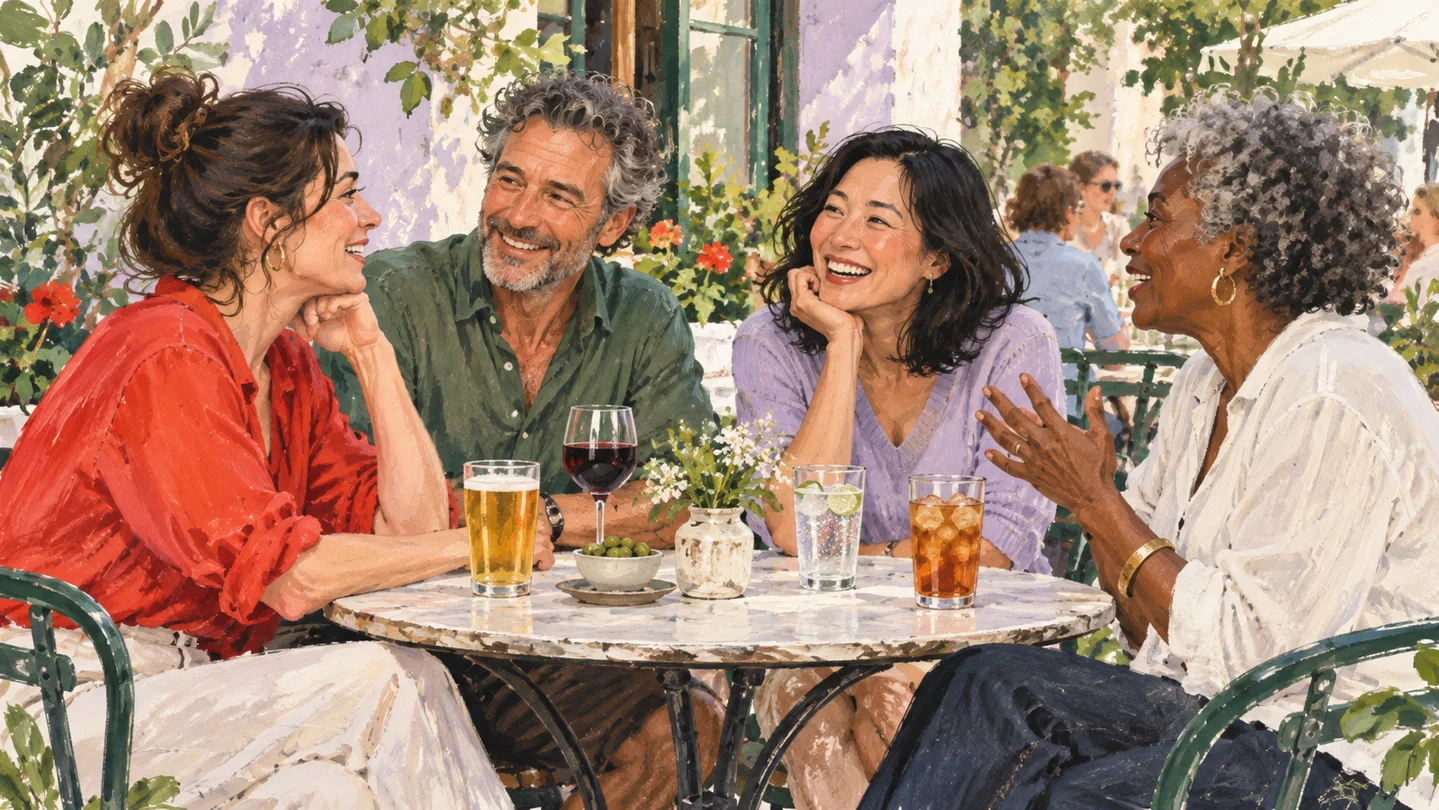
Imagine a dinner table where ordering a beer is still perfectly ordinary, but ordering nothing alcoholic attracts no attention at all. No explanation about an early start. No announcement of a challenge. Just another drink on the table.
That is a more interesting possibility than a world in which everyone suddenly gives up alcohol. What if drinking simply stopped being the default?
The number behind the question
Gallup's August 2026 report, based on its July 1–19 survey of US adults, found that 54% say they drink alcohol. That matches 2025's low in a series dating to 1939, compared with 62% in 2023.
This measures the share of adults who say they drink, not the total volume Americans consume. It is also an American finding, not a verdict on the whole world. And 54% is still a majority. Alcohol has not become a niche interest.
But it leaves room for a useful thought experiment: what would social life look like if the drink became optional without the occasion becoming any less enjoyable?
Keep the gathering. Change the order.
Much of alcohol's appeal is wrapped around things that are not alcohol: the end of the working day, a familiar room, a good meal, an excuse to sit and talk. A pint can be a drink and a small ceremony at the same time.
Those rituals do not have to disappear when the contents of the glass change. A neighbourhood pub could still be a place to meet. A wedding could still be a party. A host could offer a proper choice without dividing the room into drinkers and everyone else.
The interesting shift would be in the question. Instead of assuming wine and asking who needs an alternative, a host might simply ask what people want.
There is a business in the other glass
The drinks industry is already studying the space between abstinence and an ordinary night of drinking. In a January 2026 market update, research firm IWSR estimated that global volumes of alcohol-free beer, wine, ready-to-drink products and spirits grew 9% in 2025.
That is an estimate for a defined product category, not evidence that all its customers have stopped drinking alcohol. Someone can order an alcohol-free beer on Tuesday and a conventional one on Saturday.
Gallup likewise found that 17% of US adults had consumed alcohol-free beer, wine or spirits in place of alcohol during the previous year. Its findings point to overlap: these alternatives have customers among drinkers as well as nondrinkers.
For a bar or restaurant, the opportunity is easy to understand. A customer who skips alcohol still wants to feel welcome and may still want something more considered than a hurried glass of tap water. The test is whether the alternative tastes good and feels worth its price.
Could it become a niche pleasure?
Perhaps drinking could become more deliberate: a favourite beer with a meal, a particular bottle opened with friends, an occasional cocktail worth the trouble. Less automatic, more chosen.
That would not necessarily mean prohibition, disapproval or a lecture attached to every menu. Nor would it require pretending that everyone wants the same thing. Some people enjoy alcohol. Others dislike it, avoid it for personal or religious reasons, or find that it has caused them harm.
The appealing version of this future makes room for all of those people. Nobody has to defend the contents of their glass.
But a niche future is a possibility, not a forecast established by the data. National participation can level off or rise again. Different countries and generations can move in different directions. One survey series cannot tell us where every pub, winery or dinner party is heading.
The real change might be good manners
There is no need to wait for alcohol to become a minority habit before making social occasions easier to join. Offer appealing alternatives. Let people decline a refill. Stop treating a quiet “no thanks” as the opening bid in a negotiation.
That may be the more useful story here. The future of drinking need not be a contest between people who do and people who don't. It could be a table where the company matters more than the order.
And if alcohol eventually becomes a more occasional pleasure, the evening can still be a good one.