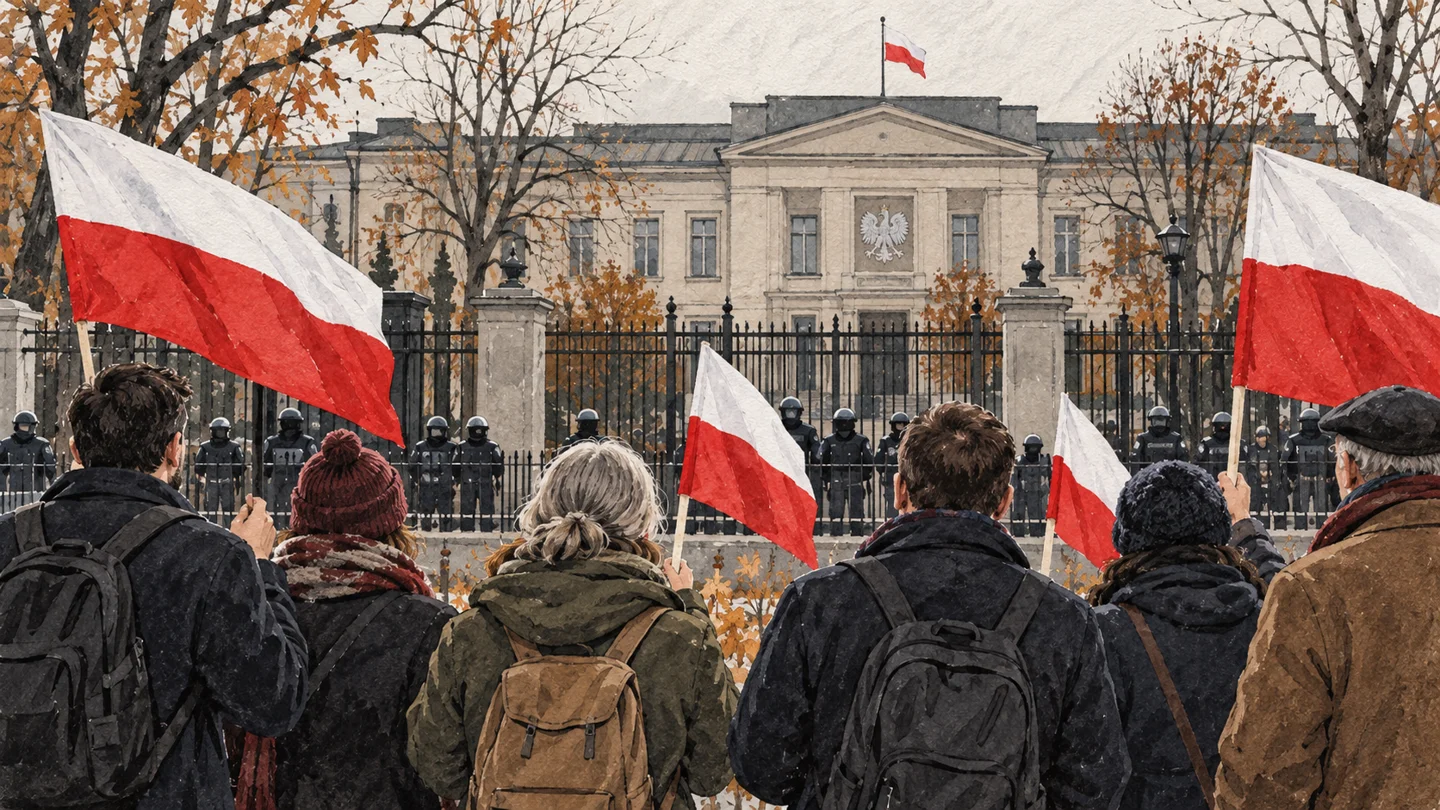
Warsaw, Poland — A dispute over who can lead Poland’s Constitutional Tribunal has brought police, protesters and the country’s president to the court’s gates, sharpening a confrontation between President Karol Nawrocki and Prime Minister Donald Tusk.
By November 1, the two camps were still offering incompatible accounts of the same events: the government calls its actions a restoration of the rule of law; Nawrocki says a constitutional institution has been taken over unlawfully.
What happened at the court?
On October 30, judge Anna Korwin-Piotrowska announced the one-month suspension of tribunal president Bogdan Święczkowski and his deputy, Bartłomiej Sochański, and assumed its leadership. The authority for those moves is disputed. DW’s account describes the suspensions and the competing claims over judicial appointments.
Police deployed around the tribunal as demonstrators gathered. Officers said they were responding to safety concerns; Warsaw police said they had not entered the building. Nawrocki cut short his flight to Senegal and returned to Warsaw, visiting the tribunal overnight.
AFP reported that police arrested three people during the confrontation. Protesters returned on Saturday, according to The Associated Press.
Why both sides say they are defending the law
Tusk’s government argues that the tribunal was politicised under Law and Justice, known as PiS, which governed from 2015 to 2023. His coalition took office promising to reverse those changes. Disputed appointments and Nawrocki’s refusal to swear in parliamentary nominees have frustrated that effort.
In his October 31 address, Tusk defended continued action and said the executive’s task was to ensure judges’ safety and working conditions. He said the tribunal should operate independently, including independently of him.
Nawrocki’s official statement called the events a forcible takeover, demanded the withdrawal of government-deployed forces and announced urgent consultations with parliamentary parties. The president also said he had facilitated access for Sochański, whom he recognised as the tribunal’s lawful vice-president.
Those are opposing legal and political positions. A suspension order, a presidential declaration or an accusation of a coup does not, by itself, resolve which side has acted lawfully.
What happens next?
Polish Radio reported on November 1 that Nawrocki’s consultations produced proposals including a reset of the tribunal and a technical government. These remain proposals, rather than an agreed settlement. It also reported that an extraordinary assembly of Supreme Court judges was scheduled for November 3.
The central question goes beyond who occupies the building: can Poland reach an accepted process for appointing judges and recognising the tribunal’s decisions? Until then, the street confrontation remains the visible edge of a deeper institutional dispute.
Follow further developments in our World News coverage.