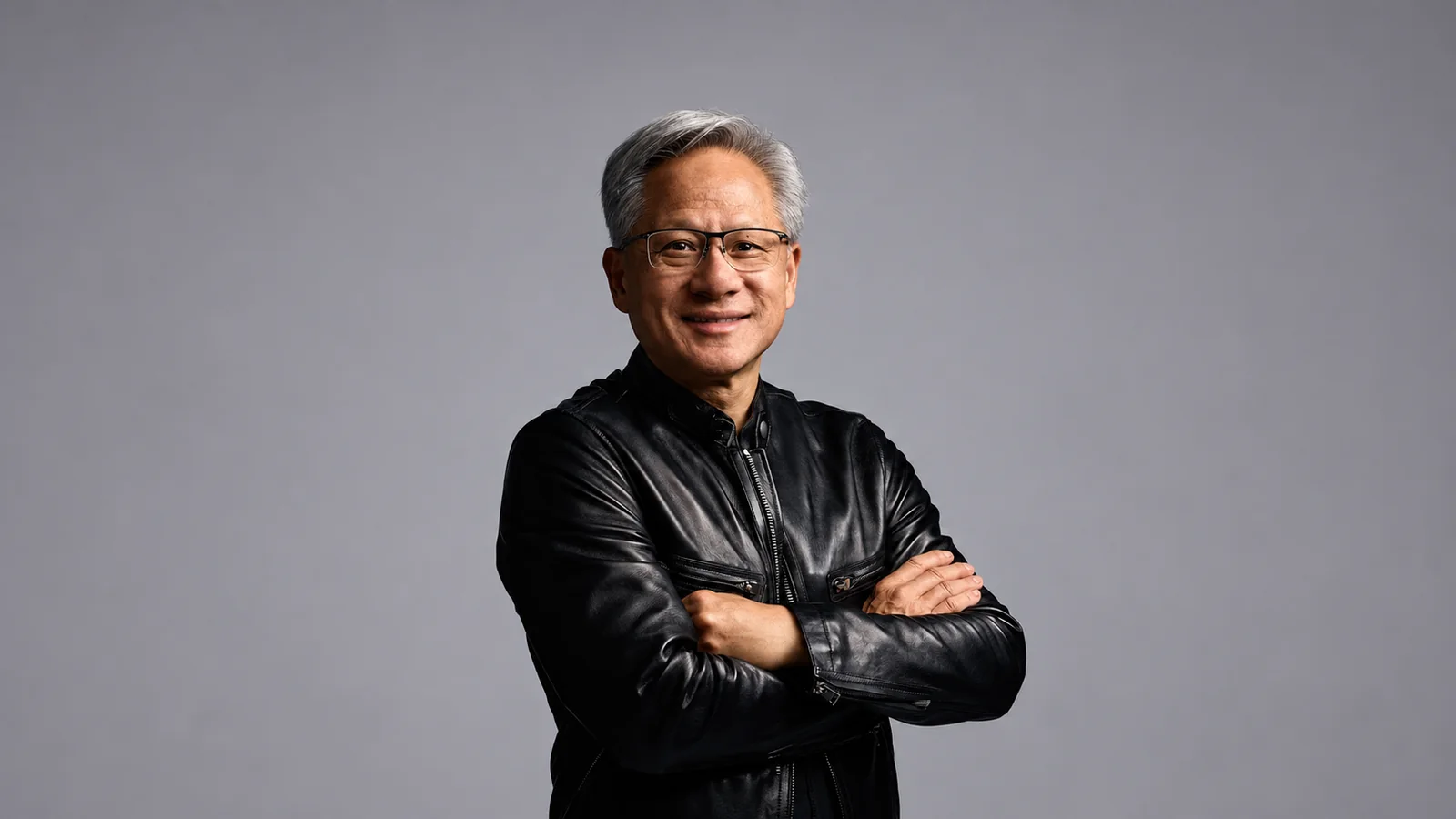
For six days, Nvidia’s position appeared settled. Jensen Huang had resigned, a veteran executive was running the company, and the board had publicly ruled out bringing its founder back.
On November 23, the answer changed. Nvidia announced that Huang would return as president, chief executive and a director. The company that had begun preparing for life after its defining figure was putting him back in charge.
It is a remarkable second act compressed into less than a fortnight. But the comeback is more complicated than a triumphant entrance: the investigation that overshadowed his departure remains open.
Before the leather jacket, a diner booth
There is an unusually ordinary setting at the beginning of this extraordinary business story. In 1993, Huang, Chris Malachowsky and Curtis Priem met at a Denny’s in Silicon Valley to discuss chips that could bring realistic three-dimensional graphics to personal computers.
Nvidia’s account of Huang’s return to the restaurant in 2023 recalls his earlier work at the chain as a dishwasher, busboy and waiter. The diner was a place where the founders could sit with coffee and develop an idea without being hurried out.
The setting makes a satisfying origin story, but the engineering preparation mattered. Huang had worked at AMD and LSI Logic. He studied electrical engineering at Oregon State and earned his Stanford master’s degree in 1992, according to Stanford’s profile. He brought semiconductor experience to the table alongside ambition.
Founders’ stories can become too tidy in retrospect. A diner meeting does not explain three decades of technical decisions, product development and work by thousands of other people. It does, however, place the eventual corporate drama in perspective: Huang’s relationship with Nvidia began before there was a company large enough to have a succession crisis.
The graphics company that found a much larger market
Nvidia dates its founding to April 5, 1993. Its corporate timeline charts a progression from PC graphics to the 1999 GPU milestone, then the 2006 unveiling of CUDA, which opened graphics processors to wider scientific and research applications.
The essential idea is accessible even if the circuitry is not. Graphics require enormous numbers of calculations. A processor built to carry out many operations in parallel can also be useful for other workloads that share that characteristic. CUDA gave developers a way to put that capability to work beyond drawing images on a screen.
The 2012 AlexNet breakthrough helped demonstrate the connection to artificial intelligence. In a 2016 essay about the emerging AI industry, Huang described how researchers trained the image-recognition network using two Nvidia GTX 580 GPUs. The research was a sign of a much larger opportunity for the hardware.
This history helps explain why Huang became so closely associated with Nvidia’s future. The company’s story involved a sustained argument about where computing was going, and its founder became the most recognisable person making that argument.
His official 2026 GTC keynote, embedded below, provides that context. It predates the November crisis; it is background on the company’s ambitions, not footage of the reinstatement.
When private conduct became a corporate crisis
The November controversy reached well beyond an executive’s personal reputation. In reporting published on November 13, Reuters described Huang’s acknowledged infidelity and a relationship with Chinese businesswoman Alice Huang, who is not related to him. Reuters also reported allegations that he had misled senior Nvidia colleagues about the relationship.
Those allegations were attributed to people familiar with the matter and correspondence reviewed by Reuters. They were not findings announced by a court or by Nvidia’s independent investigation.
The national-security question made the situation more consequential. Reuters reported US suspicions that Alice Huang had worked for Chinese intelligence, while stating it had not independently verified that allegation. Beijing denied she was a spy. Treating the suspicion as an established fact would go beyond the evidence.
There were therefore several questions running together: personal conduct, candour with company leadership, possible intelligence activity and the handling of sensitive business relationships. Resolving one would not automatically resolve the others.
November 12: an exit that sounded final
Nvidia’s November 12 transition announcement said Huang had resigned his executive positions and board seat, effective immediately. Chief financial officer Colette Kress would serve as interim CEO while continuing her finance responsibilities. Harvey C. Jones became board chair, and the company said it would search for a permanent chief executive.
The announcement was designed to reassure customers, employees and investors that operations and the product roadmap would continue. It described an experienced team and a succession process, rather than presenting a brief leave of absence.
That distinction matters. A temporary absence leaves a space waiting for someone. A search for a permanent successor signals that the organisation is preparing to fill it.
November 17: the board says no
Pressure for a return nevertheless gathered. Employees, investors and technology executives supported Huang, while President Donald Trump also expressed support, according to Reuters’ account of the November 17 earnings call. Huang indicated he would be willing to return if the board believed that best for the company.
Jones answered with an unusually direct statement: the board “does not intend to reinstate Jensen as CEO.”
Reuters reported that Jones linked the resignation to personal conduct inconsistent with company standards. Whatever discussions continued privately, the public message gave little reason to expect an imminent reversal.
The disagreement exposed a familiar problem at a much larger scale. A founder can be an employee accountable to a board and, simultaneously, the person customers and investors believe embodies the business. The legal authority to replace someone and the practical confidence to do it are different things.
The business kept moving
There was no pause button on Nvidia’s commercial obligations. Its November 17 financial results recorded quarterly revenue of US$115.8 billion, up 103 per cent from a year earlier. Data Center revenue reached US$107.6 billion.
Those figures, for the third quarter of fiscal 2027, describe a company serving extraordinary demand. They also show why leadership uncertainty could matter far beyond its headquarters: customers and partners were making commitments around an extensive computing roadmap.
The figures do not prove that only Huang could run the company. They were released while Kress was interim chief executive, and they reflect work completed across a large organisation. Equally, the existence of an operating business does not make the loss of a founder’s relationships and strategic authority trivial.
The board had to consider continuity in both senses: the ability to deliver products today and confidence in decisions shaping the years ahead.
November 23: the reversal
In its reinstatement announcement, Nvidia said directors had voted unanimously after discussions with Huang. It cited input from senior US government officials and said the board was satisfied about his candour, leadership ability and the national-security implications of his return.
Huang said he was honoured to return. Kress continued as CFO, and Jones remained board chair. The company also said its independent investigation would continue and announced a search for a chief compliance officer.
The announcement restored his authority without presenting a completed investigative report. That is the crucial qualification to the comeback: directors decided he should lead while unresolved questions were still being examined.
The news quickly became a social-media comeback story. This contemporary X post from Eric Daugherty captures that reaction; the company announcement above remains the source for the board’s decision.
The Board of Nvidia has just UNANIMOUSLY REINSTATED Jensen Huang as President and CEO EFFECTIVE IMMEDIATELY
— Eric Daugherty (@EricLDaugh) November 23, 2026
A return with different boundaries
Nvidia had already announced a standing committee for national security and export-control oversight on November 17. Chaired by Suzanne Nora Johnson, it was tasked with board-level scrutiny of those risks and access to outside expertise.
That structure is important because an extraordinary individual cannot substitute for reliable processes. Questions about restricted technology, overseas customers and disclosure need to be handled consistently, whoever occupies the corner office.
Trump’s support forms part of the story, as does the company’s acknowledgement of government input. The public record does not reveal every conversation or establish a single cause for the reversal. It would be too neat to reduce the decision to one intervention, just as it would be too neat to treat the return as a verdict on every allegation.
The next chapter is about trust
Huang’s rise took decades. His departure and return unfolded in days. That imbalance is part of what makes the episode so compelling: a reputation built through an entire technological era suddenly depended on decisions made inside a compressed corporate crisis.
For admirers, the reinstatement restores a leader who helped anticipate a profound change in computing. For sceptics, it raises an uncomfortable question about whether institutions can hold an exceptionally valuable founder to ordinary standards. Both reactions will now be tested against what the company does.
The meaningful measures are less theatrical than the comeback headlines: whether investigators can complete their work independently, whether directors explain consequential findings, and whether the new oversight arrangements have practical force.
The diner booth belongs to the origin story. The return to the executive office belongs to the next one. Huang has regained the job; the task of rebuilding confidence in how Nvidia is governed continues.
Reporting and analysis by Freeway66. Based on company announcements, published reporting and the sources linked throughout. Current to November 23, 2026; the investigations described above remain ongoing.