Washington, DC, USA - Your phone suddenly makes a sound you have never heard before.
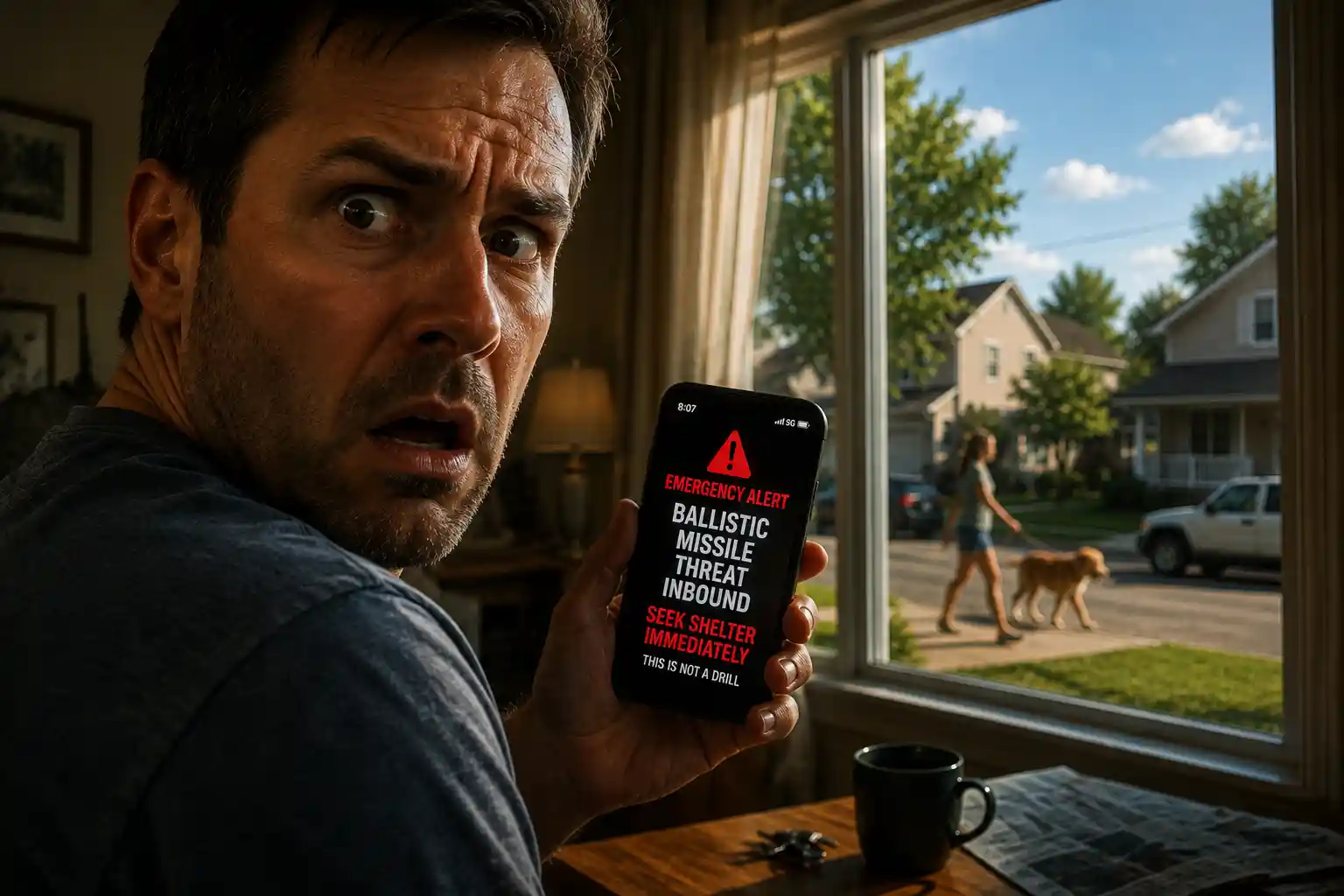
It is not a text message. It is not a weather notification. It is an emergency alert.
BALLISTIC MISSILE THREAT INBOUND. SEEK SHELTER IMMEDIATELY. THIS IS NOT A DRILL.
You read it again.
Then you look out the window.
The street looks normal. Cars are moving. Someone is walking a dog. The sky is blue.
You may have only minutes before a nuclear weapon reaches its target.
What do you do?
For millions of people, the instinct would probably be immediate: get the family into the car and drive. Put as much distance as possible between yourself and the city.
It sounds sensible.
Depending on where you are, however, it could be exactly the wrong thing to do.
The strange reality of surviving a nuclear attack is that for people outside the zone of immediate destruction, survival may depend less on escaping than on doing something considerably less dramatic:
Get inside. Get underground if possible. And stay there.
The First Enemy May Be Disbelief
We actually have some idea how people react when told a ballistic missile may be heading toward them.
On January 13, 2018, residents of Hawaii received an emergency message warning of an incoming ballistic missile and instructing them to seek shelter.
It was a mistake.
But the people receiving the message didn't know that.
For 38 extraordinary minutes, Hawaii provided an accidental real-world experiment in how ordinary people respond when told that a catastrophic attack may be imminent.
And widespread instant panic wasn't the dominant response.
Researchers from the University of Georgia found that many people initially did something remarkably human: they tried to figure out whether the warning was real.
People checked other sources. They contacted friends and family. They looked for confirmation.
Researchers call this behaviour "social milling."
In a separate study of the Hawaii alert, only 28 percent of respondents said they initially believed the warning. Another 45 percent were unsure, while 27 percent did not believe it.
That hesitation makes perfect psychological sense.
A nuclear missile attack falls so far outside normal experience that disbelief can become a coping mechanism.
But if the warning were genuine, the minutes spent trying to determine whether it was real could be among the most valuable minutes you have.
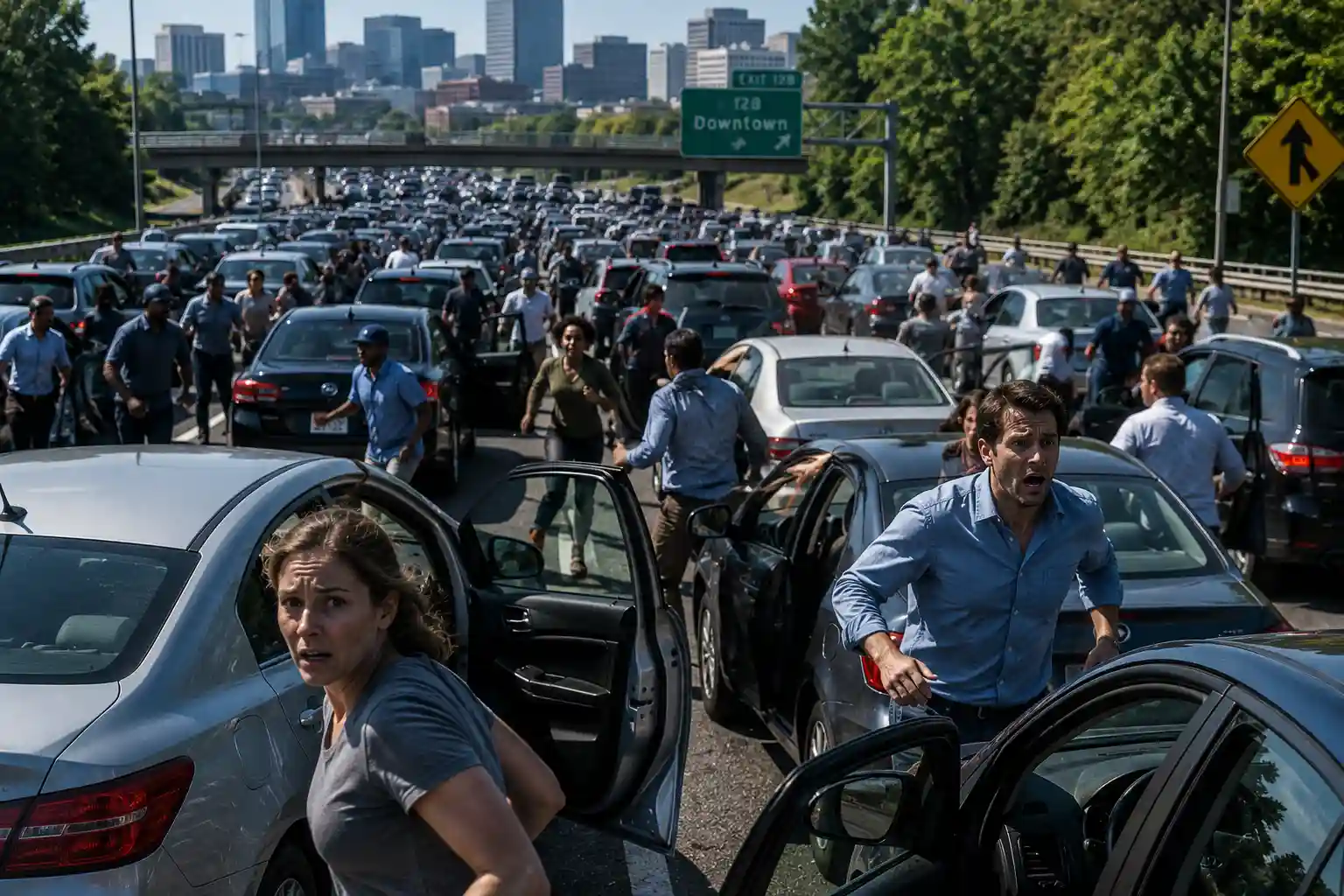
Don't Automatically Get in the Car
Suppose the alert is genuine.
Your children are home. Your car is outside. The highway leading away from the city is three minutes away.
Surely you should run.
Not necessarily.
The Centers for Disease Control and Prevention's advice for a nuclear explosion or other radiation emergency is remarkably straightforward: if you are outside, get inside the nearest suitable building as quickly as possible. If you are in a vehicle, get into a building. Brick or concrete structures and basements offer particularly useful protection, although being inside almost any substantial building is safer than remaining outdoors.
A car provides poor protection from radioactive fallout.
There is another obvious problem.
Everyone else may have the same idea.
Imagine rush hour multiplied by terror: intersections blocked, crashes occurring, people abandoning vehicles, highways filling with drivers trying to escape simultaneously.
Now imagine the nuclear detonation occurring while you are sitting in that traffic.
Your emergency supplies, bottled water and full tank of gas suddenly matter considerably less than the walls you don't have around you.
There are circumstances in which authorities may order evacuation, of course. If they do, official routes and instructions should be followed.
But "nuclear warning" does not automatically mean "drive away."
Sometimes the safer direction is down.
Your Basement Is More Useful Than You Think
Most suburban basements do not resemble fallout shelters.
There may be a furnace, a washing machine, Christmas decorations, children's toys and a collection of things nobody has looked at for ten years.
But there is something else surrounding the basement:
Mass.
Concrete. Earth. The foundation. The structure of the house itself.
Radiation protection is heavily influenced by how much material stands between a person and the radioactive source. That is why official guidance recommends moving to a basement or toward the middle of a substantial building, away from exterior walls and the roof.
You do not necessarily need an elaborate Cold War bunker.
You need shielding.
The distinction is important because popular culture has conditioned us to think about nuclear survival in extremes.
Either you are vaporized at ground zero, or you are living for six months inside a concrete bunker stocked with military rations.
There is an enormous geographical area between those two outcomes.
And within it could be millions of people whose decisions during the first few hours would matter enormously.
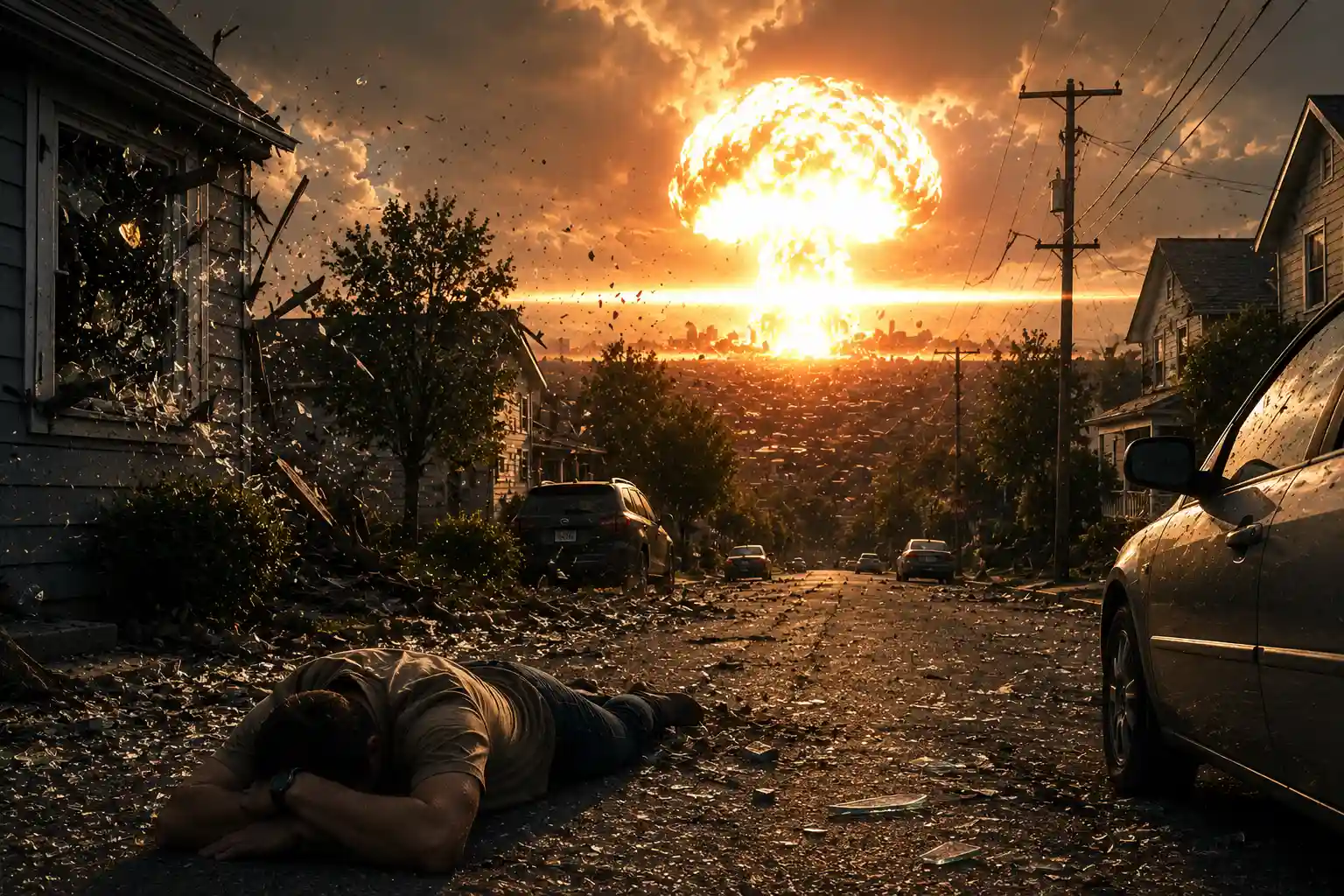
Then Comes the Flash
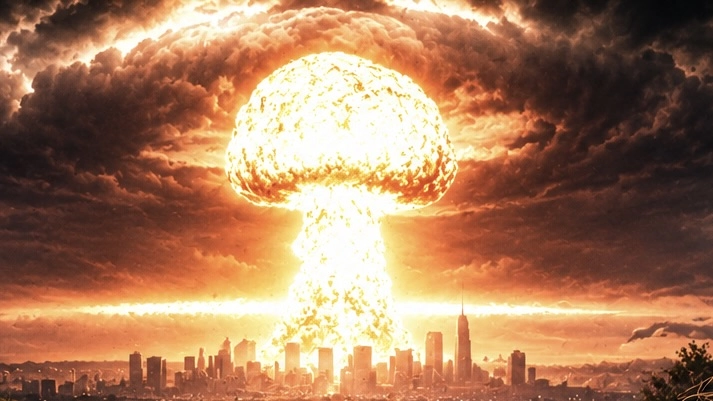
If you are close enough to see the detonation, the flash arrives before the sound.
CDC guidance says that someone near a nuclear blast should turn away, cover their eyes, drop face down and remain down until the heat and shock waves have passed.
The destruction depends on the weapon, altitude of detonation, terrain, weather and distance.
Near the centre, survival may be impossible.
Farther away, windows can shatter, structures can be damaged and people can be injured by flying debris even where buildings remain standing.
And then something psychologically dangerous happens.
The blast passes.
The house is still there.
You are still alive.
The sky may even look relatively normal.
It would be easy to conclude that you survived.
But for many people downwind of a nuclear detonation, the next phase may be the one that determines whether they actually did.
The Invisible Threat Arrives
A nuclear ground burst can pull enormous quantities of earth and debris into the fireball.
That material can become contaminated with radioactive fission products and other radionuclides before eventually returning to the ground as fallout.
Unlike the explosion itself, fallout does not necessarily announce its arrival with a deafening noise.
Radioactive contamination can settle on streets, roofs, cars, clothing and skin much like ordinary dust.
That is precisely why the hours after a detonation can be so deceptive.
The dramatic event has ended.
The dangerous period has not.
The official message is simple: stay inside.
The CDC recommends moving toward a basement or the middle of the building and remaining as far as practical from exterior walls and the roof. Windows and doors should be closed, and systems that pull outside air into the building should be turned off when possible.
And then you wait.
The 7/10 Rule
There is a remarkably useful rule of thumb for understanding nuclear fallout.
It is commonly called the 7/10 rule.
For approximately every sevenfold increase in time following a nuclear detonation, the radiation dose rate from fallout declines by roughly a factor of ten.
In simplified terms, if the radiation level at one hour is considered 100 percent, after roughly seven hours it may be around 10 percent of that level.
After roughly 49 hours, it may be around one percent.
It does not mean the environment is automatically "safe" after 49 hours. Fallout patterns vary enormously, and people should follow instructions from emergency authorities rather than calculate their own evacuation time.
But the principle explains something essential about nuclear survival:
Time is protection.
The longer radioactive fallout is allowed to decay while you remain shielded from it, the lower the potential exposure.
Current CDC guidance tells people to stay inside for at least 24 hours following a radiation emergency unless authorities say otherwise or the building itself becomes unsafe.
That can create a brutal psychological conflict.
Imagine sitting in your basement six hours after the explosion.
Nothing has happened for hours.
You want information. You want to see what's happening outside. Perhaps you want to find someone.
The danger feels as though it has passed.
That may be precisely when staying put matters most.
Fallout Can Look Like Dust
The word "radiation" conjures images of an invisible force.
Fallout itself can be much more ordinary-looking.
Radioactive material can descend and accumulate like dust or sand.
One of history's most disturbing examples came from the Castle Bravo thermonuclear test conducted by the United States at Bikini Atoll in 1954.
Fallout travelled beyond the area planners had anticipated and contaminated inhabited islands of the Marshall Islands.
On Rongelap Atoll, fallout was famously described as resembling snow.
People had no obvious reason to understand what was falling around them.
That is one of the peculiar horrors of fallout.
Something can look harmless while being anything but.
What If You Were Outside?
Suppose you were caught outdoors before reaching shelter.
You make it inside.
Now what?
One of the most effective things you can do is also one of the simplest.
Take off your outer layer of clothing.
According to the CDC, doing that alone can remove up to 90 percent of radioactive material from a contaminated person. The clothing should be handled carefully, placed in a plastic bag or other sealable container if available, and kept away from other people and pets.
Then wash.
Use soap and water. Shampoo your hair.
But there is one surprisingly specific instruction:
Don't use hair conditioner.
The CDC warns that conditioner can cause radioactive material to stick to the hair. It also recommends against aggressively scrubbing or scratching the skin during decontamination.
These are not sophisticated survival techniques.
They require no radiation suit.
No military equipment.
No $20,000 survival bunker.
Remove your clothes.
Wash.
Get behind as much solid material as possible.
Stay there.
Listen for instructions.
What About Someone Knocking on the Door?
This produces one of the darkest scenarios imaginable.
You are safely sheltered.
Someone outside needs help.
Do you let them in?
Contrary to one particularly grim assumption, official CDC guidance says that providing shelter to someone who has been outside can save their life without endangering your own, provided basic contamination precautions are followed.
Have the person remove their outer layer of clothing before entering if possible. Once inside, have them wash exposed areas and change into clean clothing.
That distinction matters.
A person exposed to radiation does not become radioactive merely because they were exposed. The concern is radioactive material carried on their clothing, skin or belongings.
Nuclear survival does not necessarily require barricading the door against everyone outside.
It requires understanding contamination.
A Man 170 Metres From Hiroshima
Perhaps the most extraordinary illustration of the value of shielding comes from Hiroshima.
On the morning of August 6, 1945, Eizō Nomura was working at the Hiroshima Prefectural Fuel Distribution Control Association.
Shortly after 8 a.m., he went into the basement to retrieve documents.
Then the atomic bomb exploded.
The building stood only about 170 metres from the hypocentre.
Thirty-seven employees had been at work.
Nomura survived.
The Hiroshima Peace Memorial Park Rest House, which now occupies the surviving building, records that Nomura had been protected in the basement when the blast struck. He eventually escaped the damaged structure and lived until 1982, reaching the age of 84.
It would be absurd to suggest that a basement makes someone invulnerable to a nuclear weapon. Nomura's survival involved an extraordinary combination of circumstances and luck.
But his story demonstrates something important.
Distance isn't the only thing that matters.
What stands between you and the blast—and later between you and radioactive material—can make an enormous difference.
The Strange Logic of Nuclear Survival
For decades, nuclear war has been portrayed as the ultimate unsurvivable event.
At the centre of a major nuclear explosion, that description is reasonable.
But cities are large. Metropolitan regions are larger.
A nuclear weapon does not produce one uniform circle in which everyone inside dies and everyone outside survives.
There are overlapping zones of catastrophic destruction, severe damage, broken windows, burns, radiation exposure and fallout.
Millions of people could conceivably find themselves outside the zone of instant destruction but very much inside the larger emergency.
For them, survival could depend upon surprisingly mundane decisions.
Don't stand at the window watching.
Don't automatically jump into the car.
Get inside.
Go downstairs or toward the centre of a substantial building.
Close the windows and doors.
Turn off systems pulling outside air inside when possible.
If you were exposed to fallout, remove your outer clothing and wash.
Then resist perhaps the hardest impulse of all:
Don't emerge simply because everything has gone quiet.
A nuclear explosion would be one of the most extraordinary events a human being could experience.
Yet some of the actions most likely to improve your chances of surviving it are remarkably ordinary.
A basement.
A radio.
Water.
A flashlight.
Soap.
And the knowledge that after the flash disappears, the emergency may have only just begun.