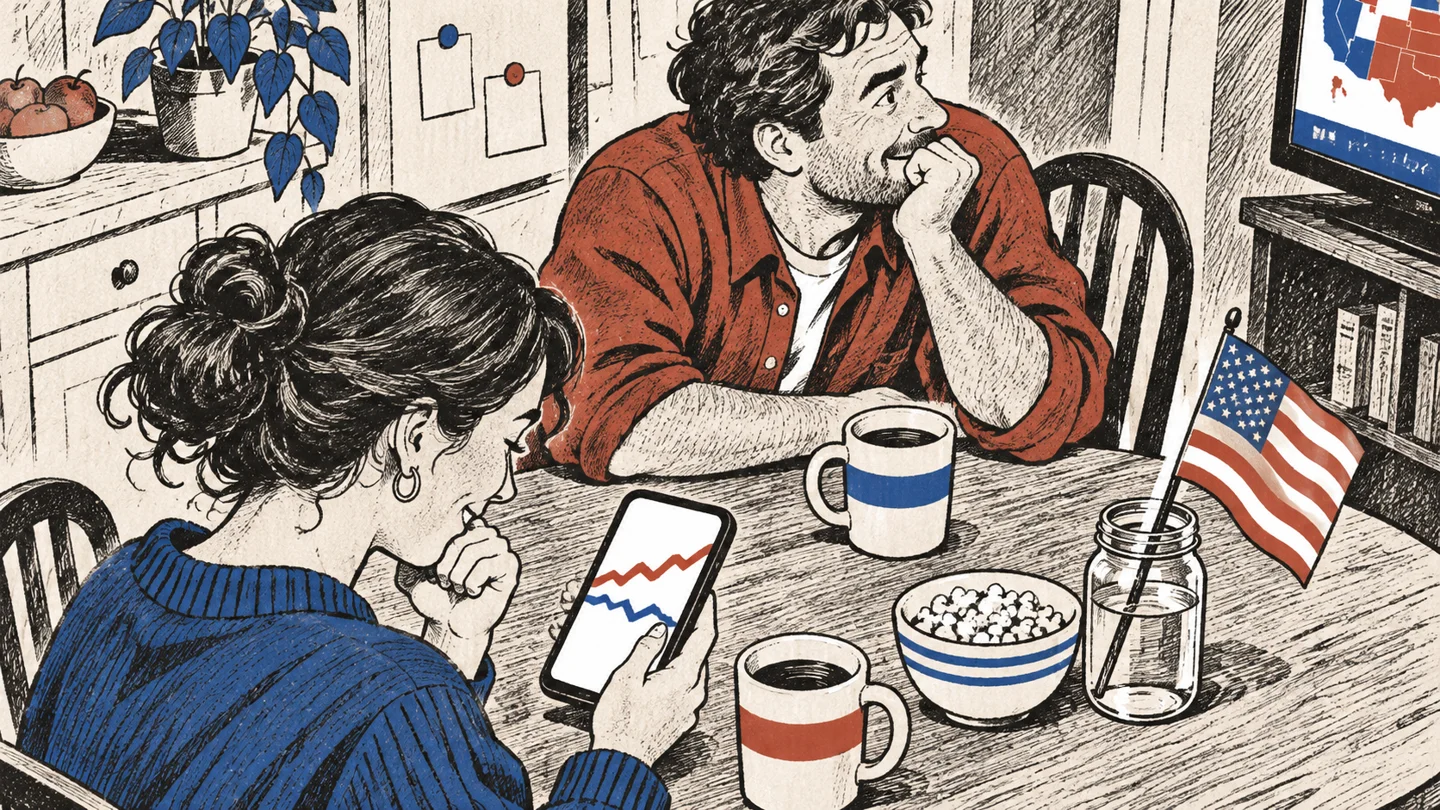
New York, NY, United States — Election night has acquired a second scoreboard. Alongside the race for Congress, traders are watching prices move on their phones, with money riding on who wins.
More than $1.48 billion has been wagered on the November 3 US midterms, Reuters reported Tuesday. Kalshi and Polymarket face a conspicuous test of their forecasting credentials. Recent election misses have also demonstrated that market favourites can lose.
A vote, a bet and a very long evening
The attraction is easy to understand: turn an opinion about politics into a position with a price. The experience can be harder to handle.
In Reuters’ interviews with election bettors, New York fintech worker Noah Poser described six-figure wagers. Alabama trader Darius Gamble said he would risk no more than $20 on anything. Florida student Yadin Eldar spoke of panic buying and selling. Different stakes, similar temptation: keep checking the screen.
What the odds actually tell you
Prediction markets let participants trade contracts tied to an outcome. A contract paying $1 if an event happens and nothing if it does not might trade at 60 cents. That price is commonly read as a 60% implied probability, before fees and other trading considerations.
It does not mean 60% of voters support that outcome. Polls ask people questions; markets reflect the expectations of people willing to trade. Neither replaces counted ballots.
In its November 2 snapshot, Kalshi put Democrats’ implied chances at 94.1% for House control and 75% for the Senate. Those are dated prices from a platform describing its own markets, not results or a promise.
Statistician Nate Silver made the case for watching these markets in this Semafor interview:
Useful signal, real money at risk
The Council on Foreign Relations’ October report sees value in election markets as forecasting tools, while warning about insider trading, manipulation and financial harm. It recommends stronger oversight and disclosure of large positions.
The odds are also becoming part of the broadcast. CBS announced that its election-night data programme would include figures from Kalshi, its official prediction market sponsor.
For anyone trying to make sense of the evening, the distinction matters: a changing price tells us what traders will pay. It cannot tell election officials which ballots to count.
For another look at how we measure money and value, read What Does a House Cost in Gold?
CNBC’s November 2 investigation examines election-contract trading and integrity concerns. CNBC discloses a commercial partnership with Kalshi.