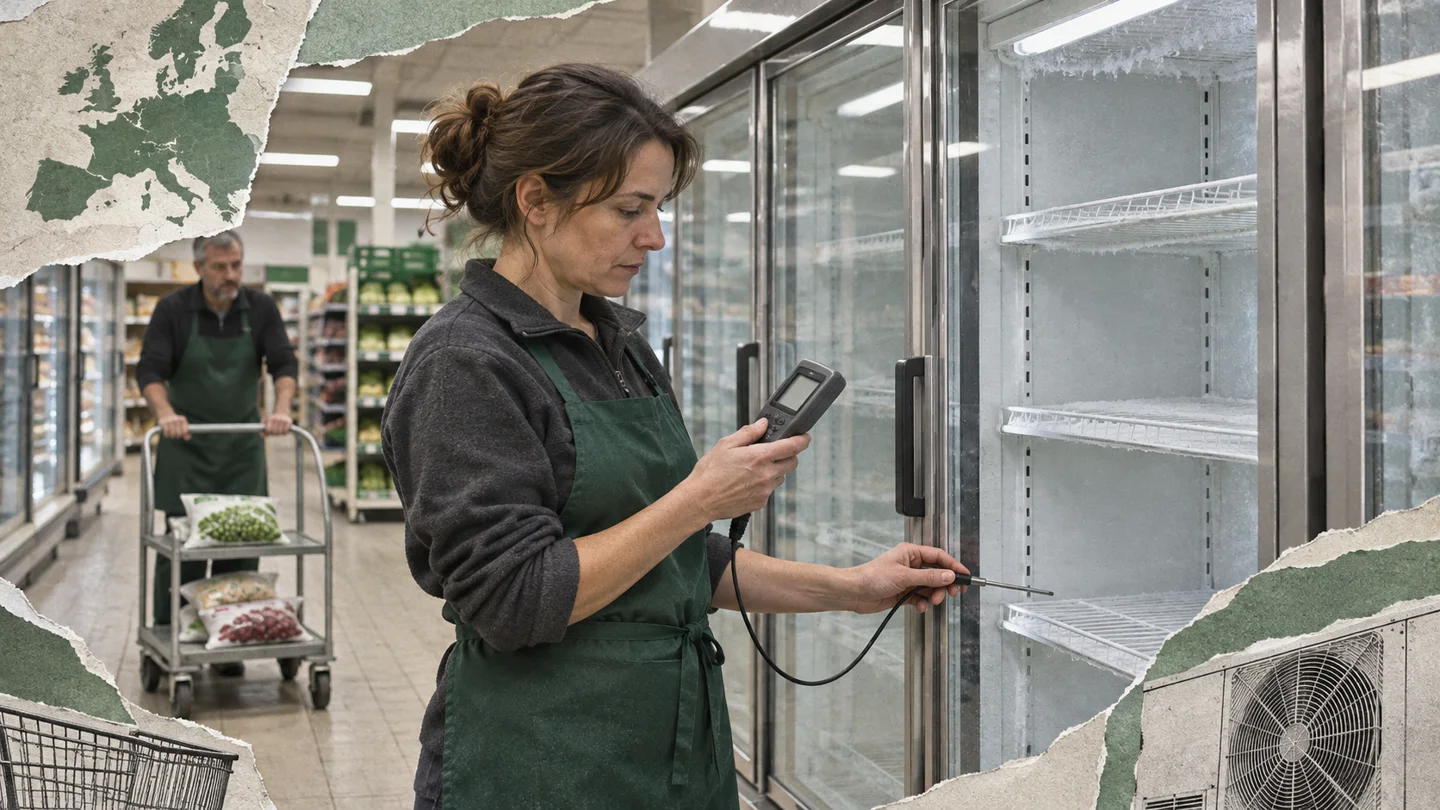
Stockholm, Sweden — Supermarket refrigeration failures across Europe have turned a cybersecurity concern into a shop-floor problem: warming cabinets, spoiled food and staff racing to protect stock.
Retailers reported incidents on November 2 in Sweden, Belgium, Luxembourg, Ireland and Estonia. Some operators described cyberattacks; others initially called them IT incidents while investigations continued. Reuters reported that no group had claimed responsibility and investigators had not established a link to last month’s attacks in France.
After the October 12 attacks in France, EU agriculture commissioner Christophe Hansen publicly condemned the targeting of food supplies.
Je condamne fermement la cyber attaque visant des produits alimentaires.
— Christophe Hansen (@CHansenEU) October 12, 2026
What happened in the stores?
According to The Associated Press, ICA said a limited number of Swedish shops were affected. Its Sjöbo branch reported that refrigeration temperatures had been set to 50°C. Coop reported problems at six stores.
Delhaize reported problems at several dozen stores in Belgium and Luxembourg, with deliveries continuing normally. Carrefour Belgium said 15 of its more than 700 stores were affected.
In Estonia, Kitman Coldtech said an incident was stopped within minutes without significant damage, AP reported. The impact was not uniform across affected shops.
A normal function, used against the shop
The Brussels Times reported accounts of settings being changed remotely and equipment entering defrost mode. Belgian store workers rushed to limit losses, with some arranging refrigerated lorries to preserve goods. Reports of individual temperatures and damage vary; they should not be treated as a single figure for every affected location.
Delhaize told Euronews it had taken immediate measures to keep stores operating. Belgium’s Centre for Cybersecurity said it was aware of an incident but initially had no further information.
Why refrigeration is an online concern
Connected controls allow equipment to be monitored and managed remotely. Refrigeration manufacturer Danfoss describes the benefits as faster alarm handling, improved performance and reduced food loss. That explains why shops use such systems; it does not identify which equipment or weakness was involved in Monday’s incidents.
The broader security challenge is addressed in joint guidance on secure connections for operational technology: organisations need to understand which systems are exposed online, whether that exposure is necessary and what protections are in place.
For continuing coverage of connected systems and their real-world consequences, see our report on emergency PHP fixes and government websites.
For now, the unresolved questions are who was responsible, how access was obtained and whether the incidents share a cause. The immediate consequence is clearer: when refrigeration fails, a digital disruption can quickly become wasted food.
This France 24 report, published on October 12, covers the earlier French attacks. It provides background; it is not footage of the November 2 incidents.