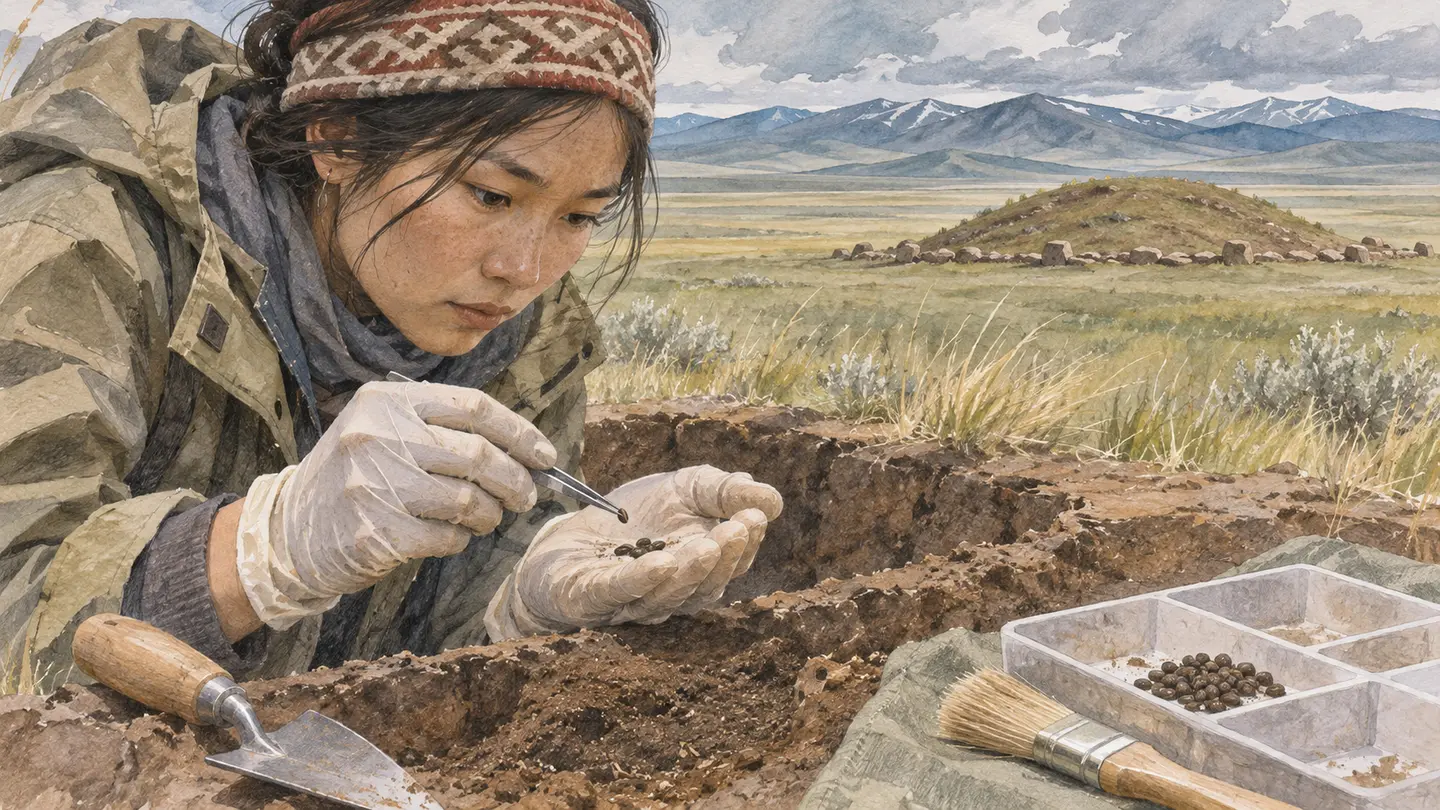
Kyzyl, Tyva, Russia — The smallest finds at a 2,800-year-old burial mound in southern Siberia may tell us something the weapons and horse gear cannot: what people took to alter how they felt. Researchers at Tunnug 1 found about a thousand cannabis seeds and chemical traces in preserved human hair. Together, the finds suggest people were using cannabis for its intoxicating effects centuries earlier than some of the clearest previous evidence.
What the seeds and hair reveal
The mound lies in the Uyuk Valley and belongs to the early Scythian world, a horse-riding culture of the Eurasian steppe. Radiocarbon dating of some seeds helped place the finds in time, The Associated Press reported. The seeds appear to come from wild plants. Their presence shows cannabis was deposited in the tomb, but seeds alone cannot tell us how it was used.
The hair is what makes the find unusual. Using high-resolution mass spectrometry, the team found signals consistent with cannabinol, or CBN, in several samples. CBN can form as THC, the main intoxicating compound in cannabis, breaks down. The team also found weaker signals consistent with THC, according to the Max Planck Institute of Geoanthropology. The researchers describe the combined evidence in a study in Science.
What the tomb cannot tell us
The research cannot establish whether people inhaled or swallowed cannabis, how much they took, or how potent the plants were. Nor does the burial setting establish that cannabis was used during the funeral. A plant placed with the dead and a chemical trace in someone’s hair are two pieces of evidence; they do not reconstruct the ceremony.
Independent specialists also questioned the interpretation of the chemical results. The Washington Post reported that the team could not quantify THC in the samples and that outside researchers raised questions about the CBN levels. That leaves room for more testing even as the pairing of plant remains and hair makes the site significant.
The team has begun sequencing plant material to learn more about how cannabis spread and was domesticated. For now, the find offers a rare connection between a plant buried with the dead and traces found in the people buried there.
For another look at how surviving objects help reconstruct ancient lives, read The Ship That Sank While the Pyramids Were Rising.
Straight Arrow’s short report introduces the discovery.