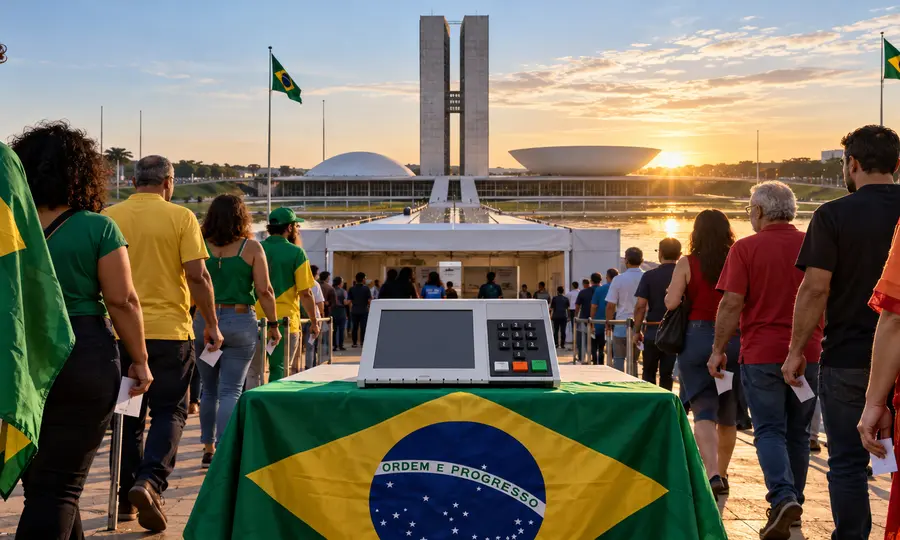
Brasília, Brazil - Brazil votes Sunday in an election that looks familiar at first glance but carries a significant generational twist. President Luiz Inácio Lula da Silva is again defending the political left, but the Bolsonaro name on the other side of the ballot now belongs to Flávio Bolsonaro, the eldest son of former president Jair Bolsonaro.
Lula enters the October 4 first round with a narrow lead. Flávio enters with something nearly as valuable: enough support to make a second-round contest a statistical toss-up.
For Latin America’s largest country, the election is about more than replacing or retaining a president. It will measure whether Lula’s economic and social record can overcome frustration over living costs and public safety—and whether Bolsonaro’s political movement can survive its founder by becoming a family dynasty.
The latest Datafolha survey gives Lula 45% of valid first-round votes and Flávio Bolsonaro 40%. In the poll’s runoff simulation, Lula leads 48% to 45%, a result still considered a technical tie within the survey’s two-point margin of error.
Other recent polling reinforces the uncertainty. Quaest found the two candidates tied at 42% in a hypothetical runoff, while an AtlasIntel/Bloomberg survey placed Flávio ahead by one-tenth of a percentage point—47.7% to Lula’s 47.6%.
With 13 candidates on the first-round ballot, neither frontrunner is expected to surpass the 50% of valid votes needed to win outright. Unless the closing days produce a major surprise, Lula and Flávio will meet again in a runoff on October 25.
The names make the contest resemble Brazil’s bitterly divided 2022 election, but the challenger is different.
Jair Bolsonaro is serving a 27-year prison sentence for conspiring to remain in power following his 2022 defeat. His son has inherited much of his conservative base, the Liberal Party’s machinery and the political symbolism attached to the Bolsonaro name.
Flávio has tried to present himself as a more controlled, business-friendly version of his father while campaigning heavily on crime, conservative social values and opposition to Brazil’s powerful judiciary. Jair’s influence remains visible even from prison, including through an AI-generated campaign avatar used to communicate with supporters.
The arrangement raises the central question of Flávio’s candidacy: Is he emerging as an independent national leader, or acting as the political vessel for his father’s return?
Public security is among the most urgent concerns facing Brazilian voters. Organized crime, gang control and violent policing have become defining issues, especially in large urban centres.
Flávio has made crime a central campaign theme, promising tougher enforcement and stronger support for police. Lula has responded by proposing better coordination between federal and state authorities while defending social programs intended to reduce the conditions that feed criminal recruitment.
The argument is not merely theoretical. An Associated Press report from Rio de Janeiro found residents creating their own anti-gang initiatives, including youth mentoring, martial-arts programs and vocational training. Those community efforts reveal how far confidence in conventional state responses has eroded.
Lula can point to lower unemployment, social spending and progress against inequality. His government has increased assistance to poorer families and introduced measures intended to help heavily indebted households.
But national economic statistics do not always match household experience. Food, fuel and other essential costs remain politically dangerous. Voters who acknowledge broader economic improvement may still feel that their personal finances have not recovered.
Lula’s coalition remains strongest among poorer voters, women, Catholics and residents of the Northeast. Flávio performs better among wealthier voters, evangelicals, conservatives and much of Brazil’s South. These familiar geographic and social divisions have made the closing campaign less about persuasion across camps than about turnout within them.
The Banco Master affair has injected fresh uncertainty into the race. The sprawling financial scandal has touched political figures, business interests and members of Brazil’s judiciary.
Flávio Bolsonaro has faced scrutiny over alleged financing connected to a film about his father and has denied wrongdoing. The scandal has also generated questions surrounding Supreme Court figures and relationships across Brazil’s political establishment.
For Lula, corruption allegations revive memories of earlier scandals associated with the Workers’ Party. For Flávio, they weaken his attempt to campaign as an outsider confronting a compromised system. The result is widespread voter disillusionment rather than a clear advantage for either side.
Datafolha places rejection of both Lula and Flávio at approximately 45%. That helps explain why the race is so stable and so close.
Millions of Brazilians are not voting with enthusiasm for a new national project. They are voting to prevent the other side from returning to power. Lula supporters fear the restoration of Bolsonaro-era authoritarian politics. Bolsonaro supporters see Lula and the courts as symbols of an entrenched establishment that must be defeated.
Both leading candidates skipped the final televised debate, leaving Brazil to finish the first round without a direct confrontation between the two people most likely to advance. It is the first time in two decades that the leading presidential candidates have both avoided such a closing debate.
Brazil is Latin America’s largest economy, one of the world’s major agricultural exporters, a leading member of BRICS and the custodian of most of the Amazon rainforest. Its political direction affects trade, climate negotiations and the balance of influence between Washington and Beijing.
A Lula victory would preserve Brazil’s current emphasis on social programs, environmental diplomacy and an independent foreign policy that maintains relationships across competing blocs.
A Flávio Bolsonaro victory would strengthen the conservative shift already visible elsewhere in Latin America and provide President Donald Trump with a closely aligned partner in the region. It could also produce a confrontation over the future of Jair Bolsonaro and Brazil’s judiciary.
The first round will probably settle only who advances, not who governs. Yet Sunday’s vote will reveal whether Lula retains enough authority to begin the runoff as the favourite—or whether the Bolsonaro movement has successfully transferred its loyalty from father to son.
According to Reuters’ closing assessment of the campaign, only about 5% of voters remain undecided. But 17% say they could still change their minds.
In a country divided almost evenly between two rival political identities, that movable minority may decide not simply the next president, but whether Brazil’s future belongs to its most enduring political veteran or its newest political dynasty.