Spokane, WA, United States — A faint moving point beyond Pluto has become a new dwarf-planet candidate—and a reminder that our own Solar System still holds surprises.
Announced on October 27, the object provisionally named 2026 ED138 was identified in observations from Chile's Vera C. Rubin Observatory. It is about 46 times farther from the Sun than Earth is. The team's preliminary size estimate spans 600 to 1,500 kilometres; follow-up observations are needed to narrow it.
BREAKING 🚨: Astronomers just found a possible new dwarf planet beyond Pluto pic.twitter.com/mwaKuy2UWx
— Latest in space (@latestinspace) October 28, 2026
Hidden among the stars
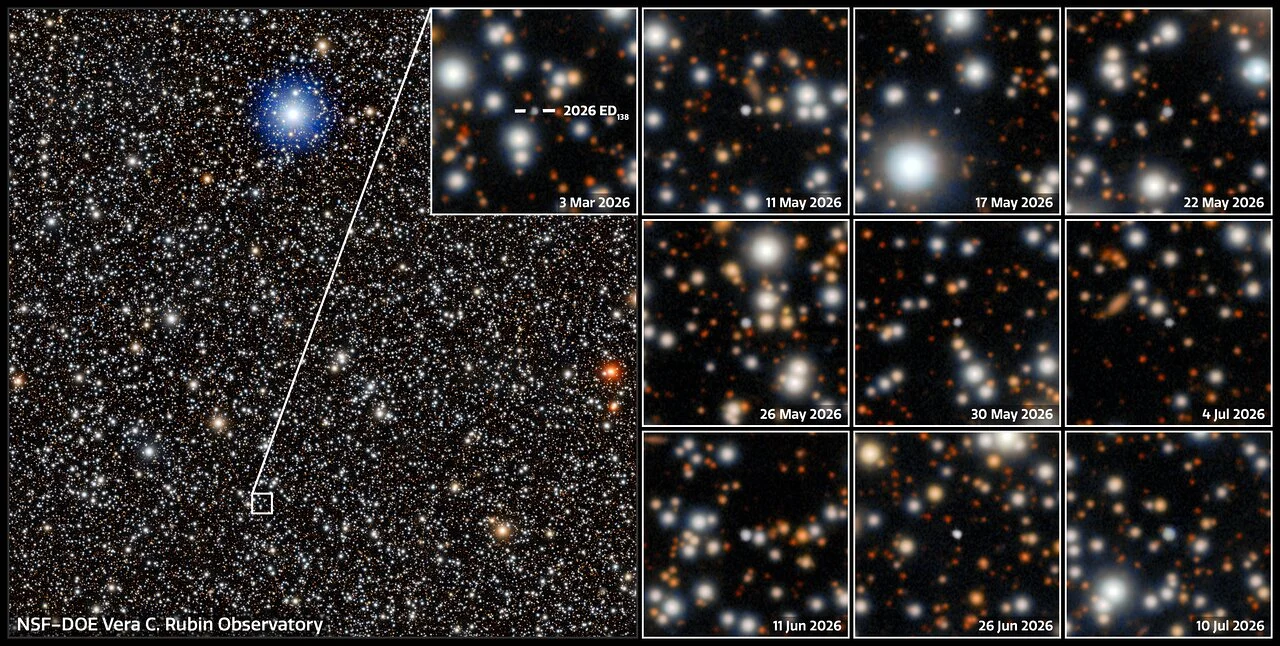
According to Rubin's discovery announcement, researcher Matthew Holman spotted ED138 while running search software through earlier survey data. The crowded Milky Way background had helped conceal it. Researchers then found additional observations, including archival images reaching back to 2016, allowing them to reconstruct more than a decade of its orbit.
The discovery was presented at a planetary-science meeting in Spokane. It is a new identification of an existing object, rather than a new world suddenly arriving in the Solar System.
Why “candidate” matters
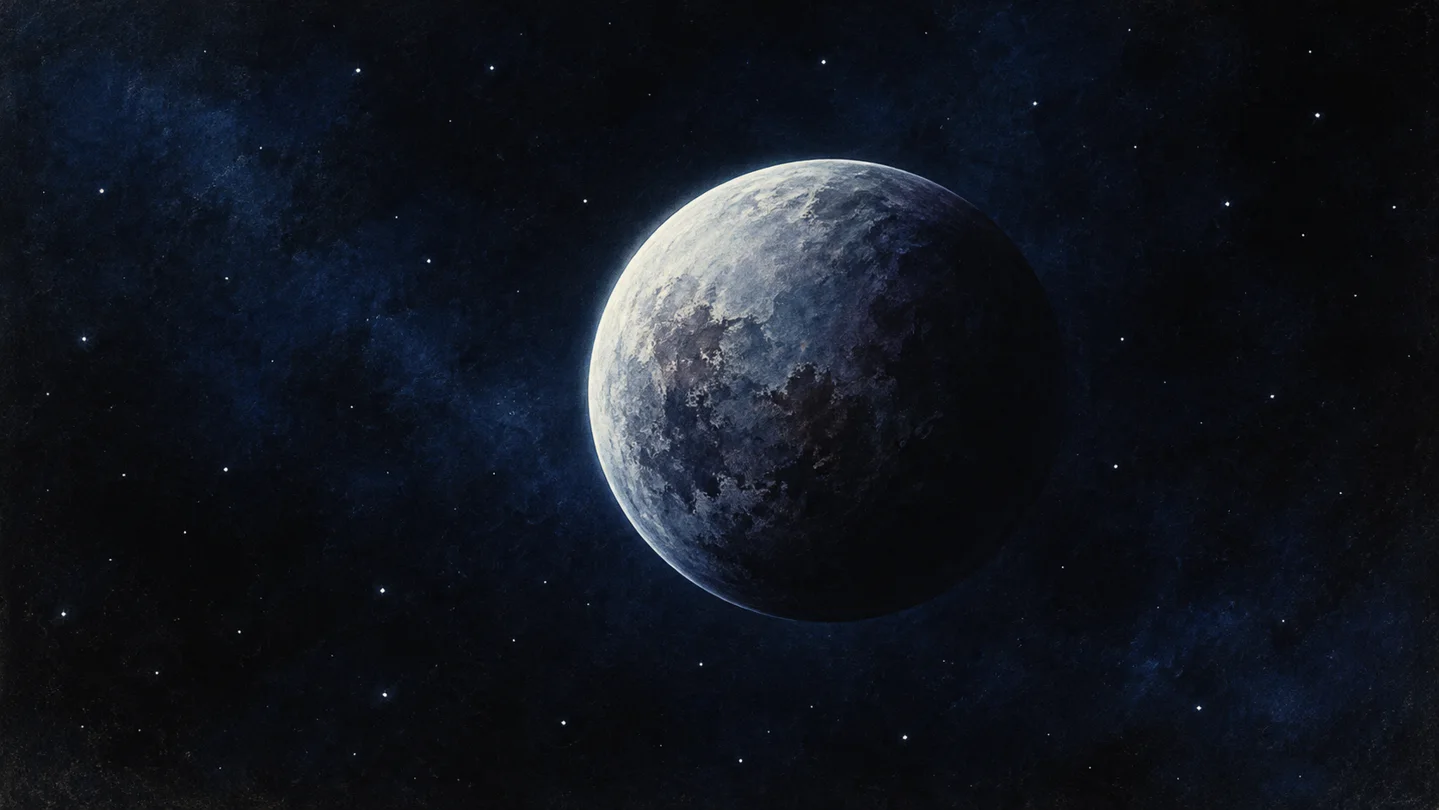
The estimate makes ED138 a promising dwarf-planet candidate, not a newly confirmed ninth planet. Its appearance in the cover illustration is conceptual: nobody has photographed its surface in close-up.
As NASA's Jet Propulsion Laboratory explains, a dwarf planet orbits the Sun, has enough mass to become nearly round under its own gravity, has not cleared the neighbourhood around its orbit, and is not a moon. Size alone is not the complete definition.
Pluto belongs to that category. “Dwarf” describes a classification; it does not mean an object is too small to be interesting. NASA's dwarf-planet overview offers more background on these small worlds.
The discovery is in the comparison
Look at the actual images and the contrast with an illustrated world is striking. The evidence begins with a point of light, not a dramatic landscape. Repeated observations let researchers distinguish movement from the background and test whether separate detections belong to the same object.
That is part of what makes this story satisfying. Better instruments matter, but so does the patient work of recognising what was already in the data.
For more on how new tools change what people can accomplish, see our feature One Lifetime, Another World.
Below, NOIRLab's animation models ED138's orbit. It is a visualisation, not spacecraft footage.
Orbit animation credit: NSF–DOE Vera C. Rubin Observatory/NOIRLab/SLAC/AURA/R. Proctor.