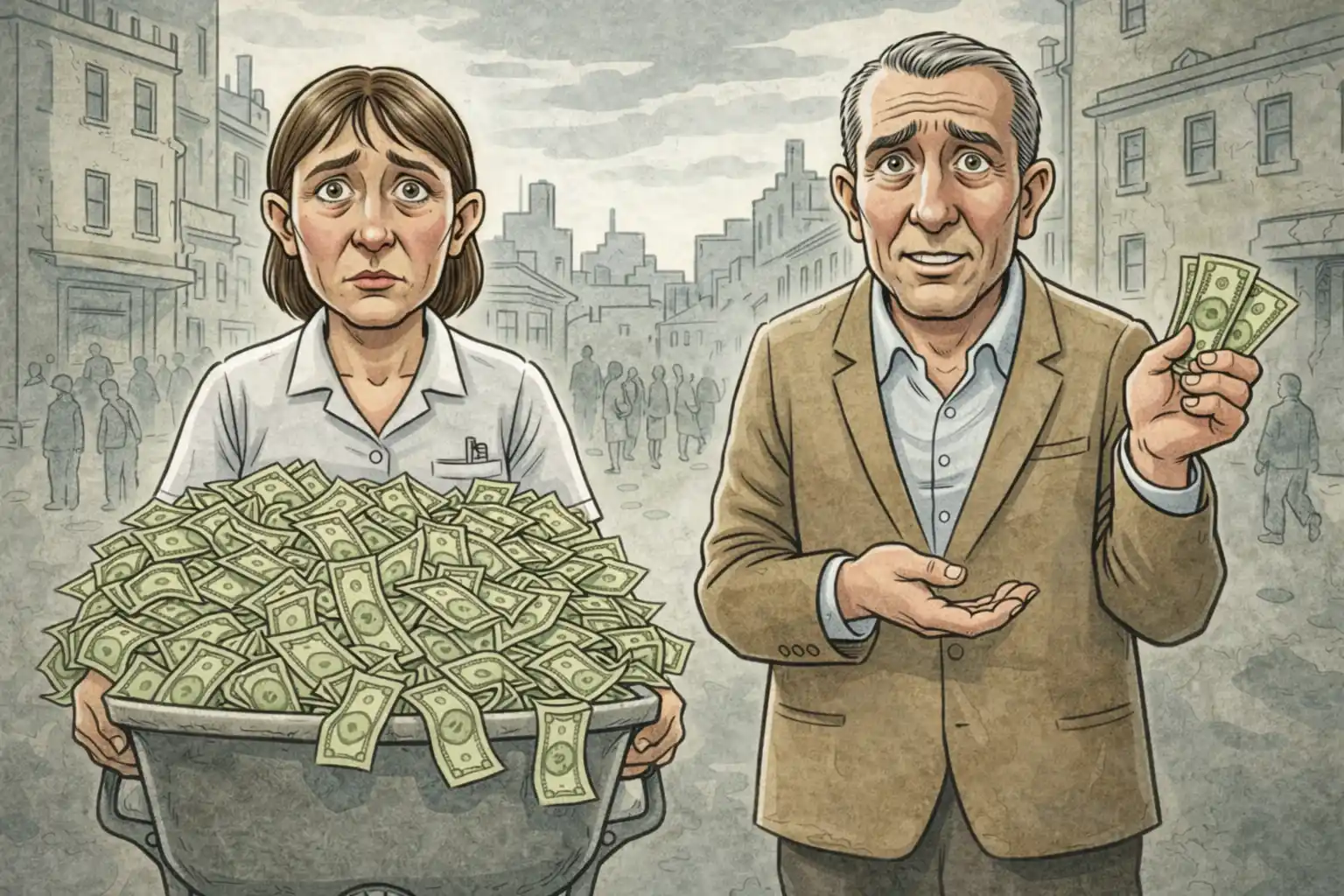
New York, NY, USA - Picture a bakery in Berlin, November 1923. You aren’t browsing pastries—you’re watching arithmetic collapse. A single loaf of bread costs 200 billion marks. Someone ahead of you isn’t carrying groceries; they’re carrying cash. By the time you reach the counter, the price has been crossed out and rewritten again.

This scene has been replayed so often online that it starts to feel like dystopian fiction. But it happened. And versions of it have happened repeatedly since—in South America, Eastern Europe, the Middle East. Different countries, different governments, same underlying failure.
Most people treat these moments as a single event: currency collapse.
That’s the first mistake.
History suggests there are actually two different failures that can hit ordinary people—and they don’t always arrive together.
- Money breaks — purchasing power collapses.
- Rules change — assets that felt “safe” become conditional.
Understanding the difference matters more than any list of “what to buy.”
Failure #1: When the Currency Breaks
Currency collapse follows a recognizable pattern. Governments spend more than they collect, borrow heavily, print to bridge the gap, distort incentives, and eventually lose credibility. When trust in the unit itself breaks, the decline accelerates.
The classic example is the Weimar Republic. In 1922, it took hundreds of marks to buy a dollar. By late 1923, it took trillions. Lebanon’s recent experience followed a similar arc, compressed into a few years instead of months. Zimbabwe and Venezuela each added their own variations.
What’s striking is not that these currencies failed—but what happened next.
When money stops working as a measuring stick, people don’t stop trading. They simply migrate toward things that retain meaning outside the collapsing unit.
Across dozens of historical case studies, a pattern emerges.
What tends to survive currency failure
1. Precious metals
Gold and silver are not productive assets and don’t need to be. Their role is simpler: they are difficult to debase and globally recognized. In hyperinflationary environments, they often preserve purchasing power—not because they “go up,” but because the unit around them is falling apart.
2. Access to foreign hard currency
When local money fails, people gravitate toward currencies that still function. This isn’t ideology—it’s survival. In many collapses, everyday commerce quietly “dollarizes” long before governments acknowledge reality.
3. Productive companies with external revenue
This part surprises people. Stock markets in collapsing currencies sometimes surge in nominal terms. That doesn’t mean prosperity—it means repricing. Firms that earn in foreign currency or export goods often fare better than purely domestic businesses because their revenues don’t decay at the same pace as local costs.
4. Essential goods during acute phases
In the earliest stages of breakdown, basic necessities become temporary media of exchange. This is tactical, not strategic. Consumables are useful when systems freeze—but they are not long-term stores of value.
The lesson here is not “buy X.”
It’s that value migrates away from the failing unit.
Silver’s “perfect storm” is no longer theoretical.
— Smart Silver Stacker (@StackSmarter) January 19, 2026
• U.S. proposing a $2.5B critical mineral stockpile
• Silver officially designated a critical mineral
• Heavy U.S. import dependence (~6,400 tons/year)
• 5 straight years of structural supply deficits
• Potential 401k… pic.twitter.com/GWTApZO0CO
Failure #2: When the Rules Change
The second failure mode is quieter—and in many ways more unsettling—because it can occur without hyperinflation.
You can keep your purchasing power and still discover that your access, ownership, or terms have changed.
Cyprus, 2013: a reminder about “safe” deposits
During Cyprus’s banking crisis, uninsured deposits above €100,000 at major banks were subjected to a bail-in. Roughly 47.5% of those balances were converted into equity to stabilize the system. Depositors weren’t robbed. The process was legal, coordinated, and approved at the European level.
The takeaway wasn’t that Cyprus was corrupt or reckless.
The takeaway was simpler: large deposits are not treated as sacrosanct capital in a crisis—they are treated as risk capital.
The U.S., 1933: rules can change even in stable systems
In April 1933, Executive Order 6102 restricted private gold ownership in the United States. Citizens were required to surrender gold at a fixed price. Months later, the official gold price was reset higher under the Gold Reserve Act.
Regardless of how one judges that decision historically, it established an enduring precedent: legal frameworks around assets can change rapidly when governments declare necessity.
Modern reminders
More recently, large-scale asset seizures—ranging from criminal forfeiture to high-profile cryptocurrency cases—have reinforced a basic truth: if assets are identifiable, regulated, and legally reachable, they are subject to rule changes.
This doesn’t mean “nothing is safe.”
It means safety is contextual.
The common thread: permissioned wealth
Modern finance runs on permissioned systems.
- Bank deposits exist inside regulated institutions.
- Retirement accounts operate under evolving tax and withdrawal rules.
- Brokerage assets depend on compliance regimes.
- Property is inseparable from taxation and legal enforcement.
Most of the time, this works. In stable periods, permissioned systems are efficient and convenient.
But during stress—especially fiscal stress—permissions matter more than principles.
A clear illustration came in 2023, when the U.S. Supreme Court ruled in Tyler v. Hennepin County that governments cannot keep surplus equity after seizing property for unpaid taxes. The case didn’t create a new risk; it exposed one that had quietly existed for decades.
Ownership, in practice, is not just about having an asset.
It’s about the terms under which that asset is recognized.
Why “emergency” changes everything
Governments don’t rewrite rules arbitrarily. They do it under declared necessity.
“Emergency” is a legal accelerant. It activates frameworks that allow extraordinary measures under ordinary law. In recent years, emergencies have been declared for public health, energy security, and financial stability.
This doesn’t mean abuse is inevitable. It means flexibility increases exactly when systems are under strain.
History shows that most major financial rule changes were not advertised as confiscations or seizures. They were framed as stabilization measures.
From a policy perspective, that distinction matters.
From a household perspective, the result can feel the same.
One of the most stable assets in the world. Can’t easily replace, cash flow, long term appreciation & benefits from inflation. pic.twitter.com/a7pqI1xCMP
— Grant Cardone (@GrantCardone) March 12, 2025
What this is not saying
This is not an argument for panic.
It’s not a call to abandon institutions or withdraw from society.
And it’s certainly not a recommendation to live like a fugitive.
The danger isn’t preparation—it’s misplaced certainty.
The people hurt most in past crises weren’t reckless gamblers. They were often careful, conventional savers who assumed that “safe” meant permanent and that rules would remain static.
They rarely do.
A calmer framework for thinking about risk
A sane response to history looks like this:
- Diversify across failure modes, not just asset classes.
- Assume that currencies can fail and rules can change—sometimes independently.
- Avoid concentrating all wealth in a single institution, jurisdiction, or legal framework.
- Recognize that liquidity, access, and ownership are not the same thing.
This is not about predicting collapse.
It’s about acknowledging that systems evolve under pressure.
Why this matters now
Every generation believes its financial system is uniquely permanent. Every generation is eventually proven wrong—though not always catastrophically.
Currencies have finite lifespans. Legal regimes adapt. Political incentives shift.
The point of studying Weimar Germany, Cyprus, or Lebanon isn’t to assume the same outcome elsewhere. It’s to recognize patterns before stress tests expose them.
History doesn’t provide certainty.
It provides range.
The adult conclusion
The real lesson isn’t “buy gold” or “hide assets” or “trust nothing.”
The lesson is that wealth behaves differently depending on how it fails.
- Sometimes it dissolves quietly through inflation.
- Sometimes it’s reclassified, restructured, or repriced through law.
If you understand both failure modes, you don’t need dramatic solutions. You need proportion.
Because the people who fare best during transitions aren’t the loudest or the most fearful. They’re the ones who noticed—early—that money can break, rules can change, and neither process sends a calendar invite.
Related analysis
Currency risk becomes easier to understand when the monetary system and individual markets are examined together. Freeway66’s analysis of silver’s structural repricing looks at how constrained supply, industrial demand and monetary pressure can converge in the price of a hard asset.