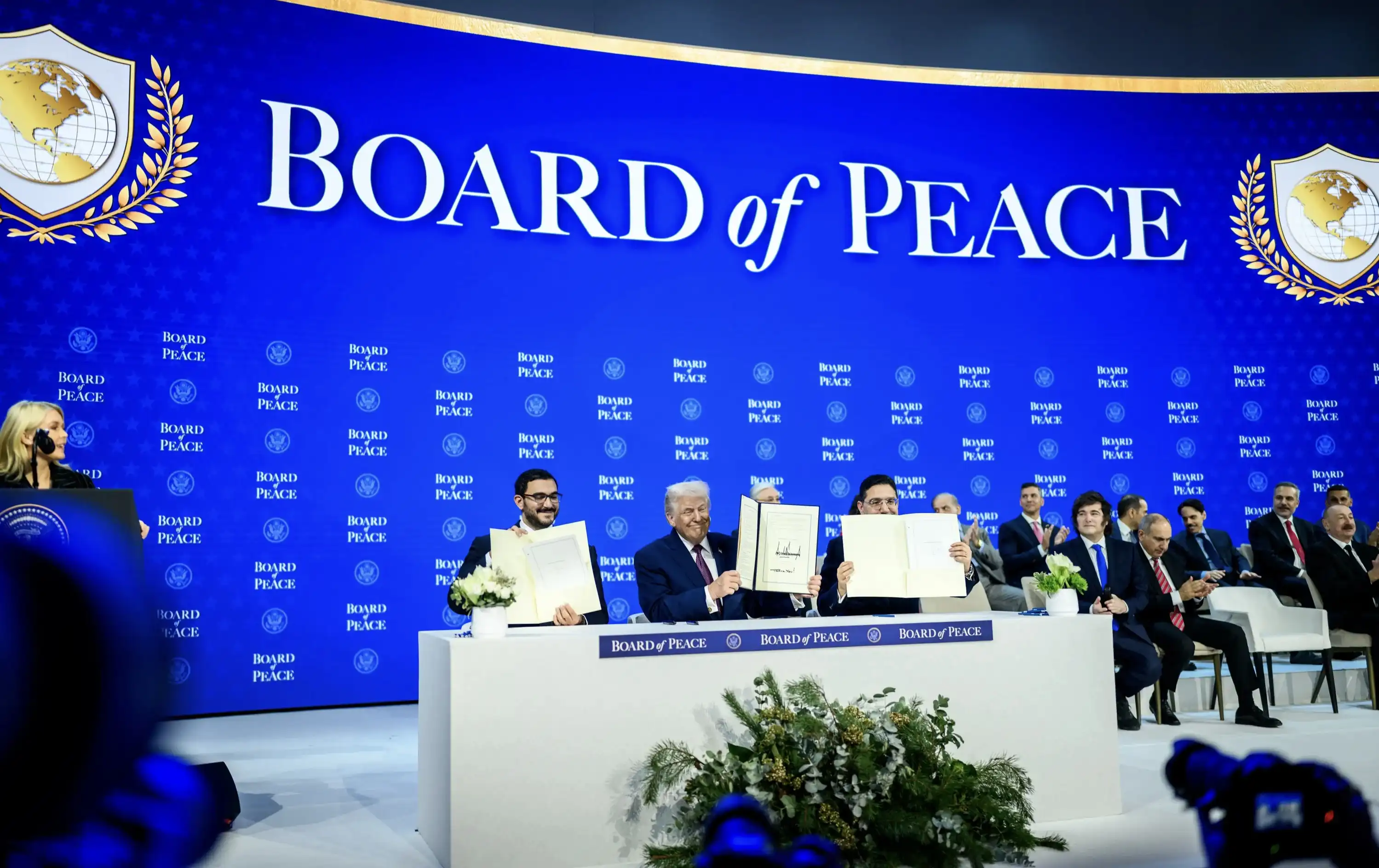
Washington, DC, USA - A new international body called the Board of Peace (BoP) has moved quickly from concept to structure, and it’s being positioned as a practical, execution-focused mechanism for post-conflict stabilization — beginning with Gaza.

Unlike many international initiatives that begin and end with statements of principle, the Board of Peace is being framed as an operating body: something designed to coordinate security, governance, and reconstruction in a unified way. It has already been referenced in a UN Security Council resolution tied to a broader Gaza stabilization framework, and the United States has taken formal legal steps to treat it as a standing international organization.
This signals something important: the BoP is not being presented as a temporary coalition or symbolic gesture — it is being built as an institutional tool.
At its core, the Board of Peace aims to solve a problem that repeatedly undermines post-war environments: fragmentation.
Historically, three elements often move separately after conflict:
When these operate independently, the result is drift. Security doesn’t stabilize because services aren’t restored. Reconstruction stalls because governance lacks legitimacy. Governance struggles because there is no security baseline.
The Board of Peace attempts to tie these three pillars together under a coordinated framework. Instead of parallel efforts running in different directions, the BoP is intended to provide a structured platform where partners align strategy, funding, and operational benchmarks.
In conflict zones, the international community frequently agrees on the end goal — peace, reconstruction, stability — but struggles with the transition phase.
The BoP appears to be designed to bridge that gap. Rather than leaving stabilization and reconstruction to ad hoc coalitions or diffuse bureaucracies, it establishes a dedicated body whose responsibility is to coordinate action and maintain momentum.
The logic is straightforward: peace-building needs a mechanism, not just a mandate.
Large multilateral institutions are essential for legitimacy, but they often move slowly due to the need for broad consensus. The Board of Peace is structured to operate more tightly, potentially allowing for faster decision-making and more direct oversight of reconstruction efforts.
This is one of its defining features: it is meant to act, not merely to convene.
A recurring failure in post-conflict regions is rebuilding infrastructure while security remains unstable — or deploying security forces without rebuilding everyday life.
The Board of Peace is built around the idea that stabilization, civil administration, and economic recovery must move together. If that integration works, it could create a reinforcing cycle: improved security allows reconstruction to proceed, and reconstruction strengthens legitimacy and stability.
One of the more debated aspects of the initiative is its funding model, which appears designed to attract significant, durable financial commitments from participating states.
While critics question the optics, supporters argue that reconstruction requires predictable capital, not short-term pledges that evaporate once media attention fades. A structure that encourages sustained investment may increase accountability and long-term planning.
The Board of Peace has already been referenced in a UN Security Council resolution connected to Gaza stabilization efforts. Additionally, the United States has taken domestic legal steps to recognize it as a public international organization for purposes of privileges and immunities.
This combination suggests durability. It signals that the BoP is intended to function as a standing institution rather than a temporary initiative.
Framed in the most constructive light, the Board of Peace represents an attempt to do something the international system has often struggled to do: connect authority, responsibility, and financing in one place.
Peace efforts fail when no one owns the middle ground between war and normalcy. The BoP is designed to own that middle ground.
Supporters argue that a smaller, more directed structure may be exactly what is required in fragile environments where speed, coordination, and clarity of mandate matter more than procedural complexity.
If successful, the Board of Peace could serve as a template for future post-conflict frameworks — one that blends international legitimacy with operational discipline.
For the Board of Peace to become more than a headline, several indicators will matter:
If those elements materialize and produce tangible outcomes, the Board of Peace may be remembered as an ambitious but necessary evolution in how post-conflict reconstruction is handled.
If not, it will join the long list of well-intentioned international frameworks that promised more than they delivered.
The Board of Peace is controversial because it attempts something bold: creating a focused, structured mechanism to coordinate peace-building in real time.
It is not merely a diplomatic slogan. It is an effort to build an operating system for stabilization and reconstruction.
Whether one views it with optimism or caution, it represents a clear attempt to move beyond symbolic resolutions and toward practical governance — and in a world where conflicts often outlast the headlines, that intention alone makes it worth serious attention.