Tehran, Iran - For nearly half a century, the idea of a Pahlavi restoration in Iran belonged mostly to nostalgia, diaspora politics, and the occasional protest chant. But the extraordinary events unfolding in 2026 have pulled that once-remote possibility back into serious discussion.
The death of Iran’s Supreme Leader during a joint U.S.–Israeli military strike has shaken the foundations of the Islamic Republic and triggered a power struggle in Tehran.
At the same time, the country has been experiencing mass protests, economic collapse, and open challenges to the clerical regime.
Against this volatile backdrop, the exiled son of the last Shah—Crown Prince Reza Pahlavi—has once again emerged as one of the most recognizable opposition figures and a symbol of a possible post-Islamic-Republic Iran.
But could he really return?
The answer lies somewhere between history, geopolitics, and the unpredictable nature of revolutions.
🚨 JUST IN: President Trump is asked if exiled Iranian Crown Prince Reza Pahlavi is under consideration to lead the country
— Eric Daugherty (@EricLDaugh) March 3, 2026
"I guess he is, some people like him. We haven't thought too much about that. It seems to me somebody from within would be more appropriate. He looks like… pic.twitter.com/BkqUlNuUkW
The Current Situation: Iran in a Leadership Crisis
Iran today is experiencing one of the most dramatic political crises since the 1979 Islamic Revolution.
Recent events have unfolded rapidly:
- A joint U.S.–Israeli military operation targeted Iranian leadership and infrastructure, killing Supreme Leader Ayatollah Ali Khamenei and other senior figures.
- Tehran has retaliated with missile attacks on U.S. bases and Israeli targets across the region.
- Hezbollah has joined the conflict, further expanding the regional war.
- Iran’s political system has temporarily shifted to an interim leadership council while clerics attempt to appoint a new Supreme Leader.
Meanwhile, a major question looms over Tehran: who will ultimately control Iran’s future?
One potential successor inside the system is Mojtaba Khamenei, the late leader’s son and a hardline cleric closely linked to the Revolutionary Guard.
But outside the system, a very different name has resurfaced.
The Exiled Prince
Reza Pahlavi was only a teenager when his father—Shah Mohammad Reza Pahlavi—was overthrown in the Islamic Revolution of 1979.
The Shah had ruled Iran as a Western-aligned monarch whose modernization drive transformed the country but also generated deep resentment due to political repression and inequality.
After the revolution:
- The Pahlavi family fled Iran.
- The monarchy was abolished.
- Iran became an Islamic Republic governed by clerics.
For decades, Reza Pahlavi lived largely in exile in the United States.
Yet he never entirely disappeared from politics.
Over the years he:
- maintained a government-in-exile style opposition network
- built support among the Iranian diaspora
- called for the removal of the Islamic Republic and a democratic referendum on Iran’s future system.
Importantly, Pahlavi often emphasizes that Iranians—not he—should decide whether the country becomes a monarchy or a republic.
Nixon reveals what the Shah of Iran, Mohammad Reza Pahlavi, said to to him during their last meeting. pic.twitter.com/hydgr9FH36
— Richard Nixon Foundation (@nixonfoundation) January 12, 2024
The Protests That Changed the Conversation
The dramatic protests that began in late 2025 and escalated into 2026 have been one of the most significant domestic challenges to the regime in decades.
These demonstrations:
- began in Tehran’s Grand Bazaar and spread nationwide.
- involved millions of participants according to some diplomatic estimates.
- united an unusual coalition of monarchists, republicans, secular activists, and ethnic groups.
During these protests, something striking occurred.
For the first time in decades, monarchist chants began appearing openly in the streets.
Some demonstrators shouted:
“Reza Shah, rest in peace.”
“Long live the Shah.”
These slogans referred to the Pahlavi dynasty and its founder, Reza Shah—the grandfather of the current exiled prince.
To supporters, these chants symbolized nostalgia for a period when Iran was wealthier, more secular, and globally connected.
To critics, they reflected frustration rather than genuine monarchist revival.
Noor Pahlavi daughter of Reza Pahlavi (heir to the throne of the former Pahlavi dynasty)
— Mambo Italiano (@mamboitaliano__) March 4, 2026
She is the symbolic “Crown Princess” of Iran for many Iranian monarchists in exile, often seen as a potential future Queen if the current regime fell and the monarchy was restored
🇮🇷👑 pic.twitter.com/6RakUeDgxk
Why Some Iranians Look Back to the Monarchy
The appeal of the Pahlavi name is rooted partly in comparative memory.
For some Iranians—especially younger generations—life before the revolution has acquired an almost mythic quality.
Supporters argue that under the Shah:
- Iran experienced rapid modernization
- women enjoyed broader social freedoms
- the country maintained strong economic ties with the West.
In contrast, the Islamic Republic has been marked by:
- international sanctions
- political repression
- economic crises
- isolation from much of the global system.
This contrast fuels the emotional power of the Pahlavi brand.
But the Reality Is Complicated
Despite the renewed attention, the path to a Pahlavi restoration is extremely uncertain.
There are several major obstacles.
1. Fragmented Opposition
Iran’s anti-regime movement is deeply divided.
Opposition factions include:
- monarchists
- secular republicans
- Kurdish and regional autonomy movements
- the controversial MEK organization.
These groups share a desire to remove the clerical system but disagree sharply about what should replace it.
2. Limited Organization Inside Iran
Analysts note that Reza Pahlavi has little formal organizational structure inside the country itself, which makes translating symbolic support into real political power difficult.
3. Memories of the Shah’s Rule
Many Iranians—especially older generations—remember the Shah’s security services and authoritarian governance.
For them, a monarchy represents a return to the past rather than a new beginning.
What Pahlavi Himself Actually Wants
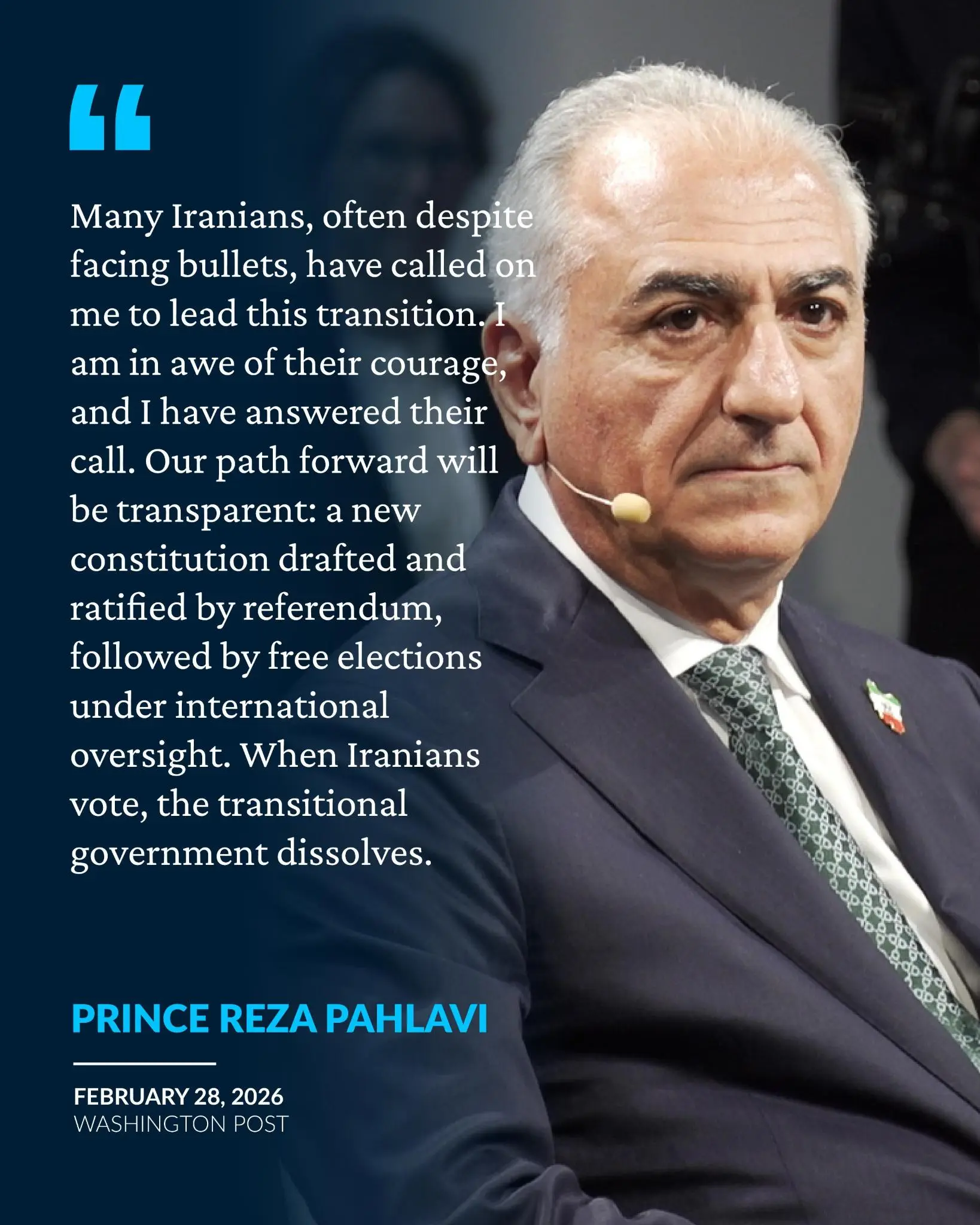
Interestingly, the prince has tried to position himself less as a future king and more as a transitional figure.
His public message often includes three steps:
- End the Islamic Republic
- Form a transitional government
- Hold a national referendum on the political system
That referendum could produce:
- a republic
- a constitutional monarchy
- or another system entirely.
Pahlavi says the choice must belong to the Iranian people.
Three Possible Futures for Iran
Analysts generally see three broad scenarios emerging from the current crisis.
1. Regime Continuity
The Islamic Republic survives the crisis.
A new Supreme Leader—possibly Mojtaba Khamenei or another cleric—takes control.
This is the most likely short-term outcome, since the regime’s institutions were designed to survive leadership changes.
2. Revolutionary Collapse
Mass protests, military defections, and economic collapse combine to topple the regime.
A transitional coalition government emerges.
This is where figures like Reza Pahlavi could play a significant role.
3. Fragmentation and Chaos
The regime collapses but no unified opposition emerges.
Iran could face:
- competing militias
- regional breakaways
- prolonged instability.
Many analysts fear this scenario more than any other.
The Monarchy Scenario
If Iran ever did restore the monarchy, it would almost certainly look nothing like the Shah’s rule.
Most supporters envision something closer to Spain’s constitutional monarchy after Franco:
- a symbolic king
- elected government
- democratic constitution.
In that scenario, Reza Pahlavi would serve more as a national figurehead than a ruler.
A Symbol More Than a King?
Ultimately, the significance of Reza Pahlavi may not lie in whether he becomes king.
His real political power may be symbolic.
In times of upheaval, revolutions often rally around recognizable figures.
In Iran’s fragmented opposition landscape, Pahlavi’s name provides something rare:
- historical legitimacy
- international recognition
- a simple narrative of national continuity.
A Moment That Could Reshape the Middle East
Iran sits at the center of a geopolitical web stretching from Lebanon to Yemen and from Israel to Central Asia.
Whatever emerges from the current crisis will reshape:
- Middle Eastern alliances
- global energy markets
- the future of regional conflicts.
For now, the Islamic Republic still stands.
But the fact that people are once again discussing the possible return of the Shah’s son shows how dramatically Iran’s political landscape is shifting.
History has a way of circling back in unexpected ways.
And in Iran, the ghost of the monarchy is no longer just history—it is part of the conversation again.