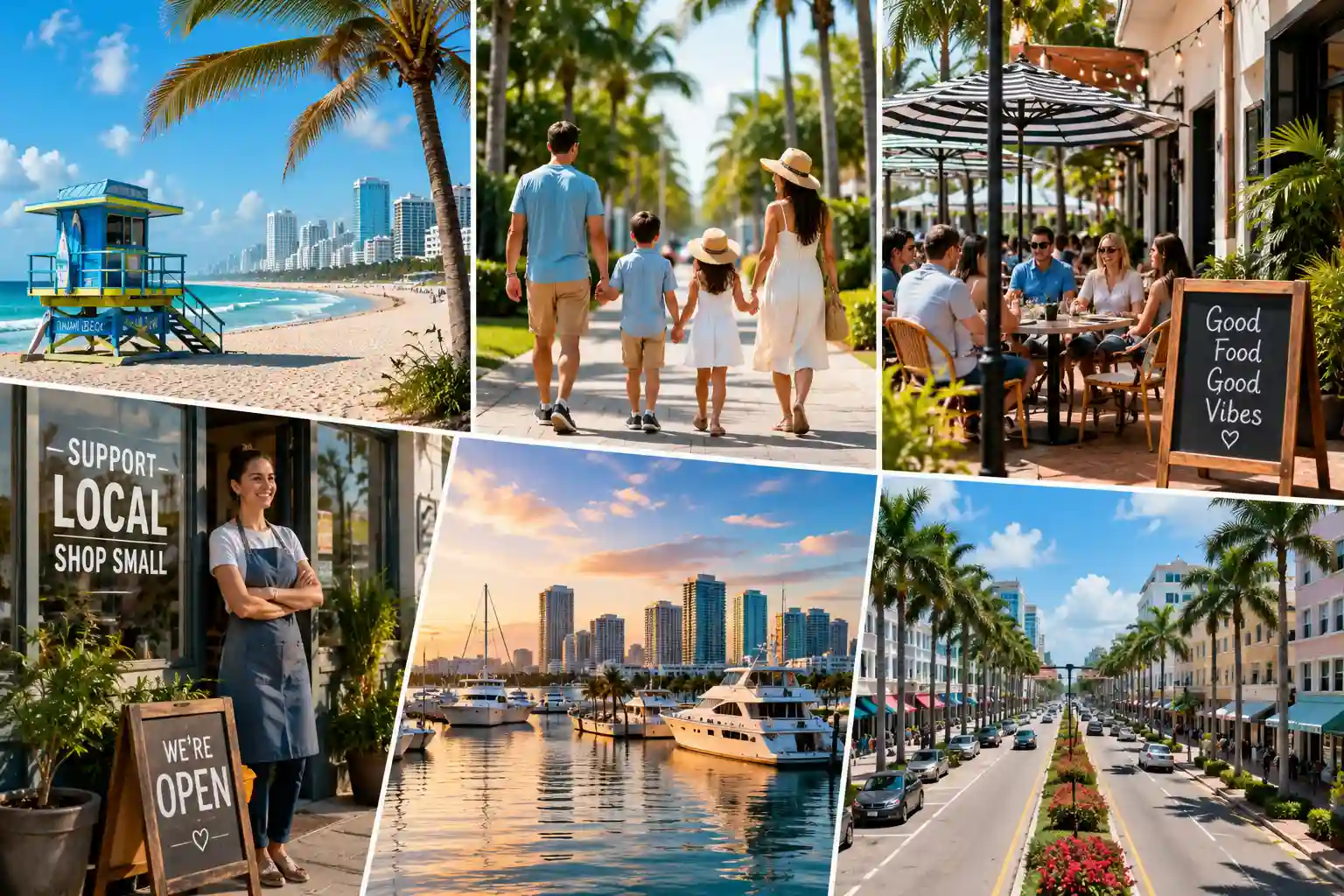
Tallahassee, FL, USA - For decades, Florida carried a familiar image.

It was America's vacation playground. A retirement destination where snowbirds escaped the winter, families flocked to the theme parks, and millions visited the beaches each year before returning home.
Today, that picture feels incomplete.
Over the last five years, Florida has undergone one of the most significant transformations of any state in America. Population has surged, businesses have expanded, investment has poured in, and the state's economy has become one of the nation's most influential.
Whether one agrees with every political decision made along the way is almost beside the point.
The bigger story is that millions of Americans made one of the most important decisions possible—not with a ballot, but with a moving truck.
Migration is perhaps the clearest measure of confidence.
People relocate for many reasons: employment, affordability, weather, family, opportunity or simply the hope of building a better future.
Since 2020, Florida has consistently ranked among the nation's leading destinations for new residents. Families arrived from across the United States. Entrepreneurs opened businesses. Retirees continued to arrive in large numbers, while younger professionals increasingly viewed Florida as somewhere they could both work and enjoy a high quality of life.
It wasn't one company announcing an expansion.
It wasn't one government program.
It was millions of individual decisions made independently of one another.
That alone makes the story remarkable.
Florida's economy didn't simply grow—it diversified.
Technology firms expanded.
Financial companies established major operations.
Healthcare continued its rapid growth.
Construction boomed to meet demand.
Tourism remained one of the world's strongest while logistics, manufacturing and professional services continued to expand.
Today, Florida possesses one of the largest economies in the United States.
Cities like Miami, Tampa, Orlando, Jacksonville and Naples each developed distinct identities while contributing to the broader success of the state.
Rather than relying on one industry, Florida increasingly became an economy built on multiple engines.
Small business has long been one of America's defining strengths.
Florida became one of the places where entrepreneurs believed opportunity still existed.
Restaurants opened.
Trades expanded.
Professional services flourished.
Construction companies, technology startups, medical practices and countless local businesses found customers in communities that seemed to be growing almost continuously.
No economic boom guarantees success for every business owner.
But growth creates possibility.
Florida provided that possibility for thousands of people willing to take the risk.
Weather undoubtedly remains part of Florida's appeal.
Warm winters, miles of coastline and year-round outdoor living continue to attract residents from colder climates.
Yet weather alone cannot explain what happened.
Many warm destinations exist throughout the world.
Florida became something more than a pleasant climate.
It became a destination associated with optimism.
For many newcomers, moving wasn't simply about escaping winter.
It represented a fresh beginning.
Population growth often attracts attention.
What received less attention was the amount of investment and household wealth arriving alongside those new residents.
Professionals, business owners, retirees and investors relocated substantial financial resources into the state.
New housing developments appeared.
Commercial buildings expanded.
Infrastructure projects accelerated.
Local economies benefited from increasing consumer activity.
The result has been a state that today plays a larger role in the American economy than at any previous point in its history.
Political observers also noticed something changing.
For decades, Florida was viewed as America's quintessential swing state.
Every presidential election seemed capable of being decided by razor-thin margins.
That picture has changed considerably.
Republicans now enjoy a clear statewide advantage in voter registration and have won recent statewide elections by comfortable margins.
Whether that trend continues indefinitely remains to be seen.
Politics evolves.
Coalitions change.
New generations emerge.
But there is little question that Florida today occupies a different political position than it did just a decade ago.
No success story is without obstacles.
Rapid growth has placed pressure on housing.
Roads have become busier.
Insurance costs have risen.
Schools, utilities and infrastructure continue adapting to expanding communities.
These are genuine issues deserving thoughtful attention.
Yet they are also, in many respects, the challenges of success rather than decline.
Communities experiencing growth must continually invest in keeping pace with that growth.
Florida's next chapter will involve managing that success wisely.
Perhaps the most interesting aspect of Florida's transformation is that it wasn't driven by one defining event.
It happened gradually.
One family relocated.
Then another.
A business expanded.
A new neighbourhood emerged.
A downtown added restaurants, offices and apartments.
Viewed individually, each decision seemed ordinary.
Viewed together, they reshaped an entire state.
History often works this way.
Major transformations are usually built from thousands—or millions—of individual choices.
America has always been a nation of movement.
People continually search for opportunity, community and the chance to improve their lives.
Over the past five years, few places have attracted that search more successfully than Florida.
Its story is still being written.
Challenges remain.
Growth will continue to require thoughtful planning and responsible leadership.
But the broader trend is difficult to ignore.
Florida has evolved from being primarily known as America's favourite vacation destination into one of its most dynamic economic and demographic success stories.
For millions of people, the Sunshine State became more than somewhere to visit.
It became home.
And in the end, perhaps that is the strongest endorsement any place can receive.